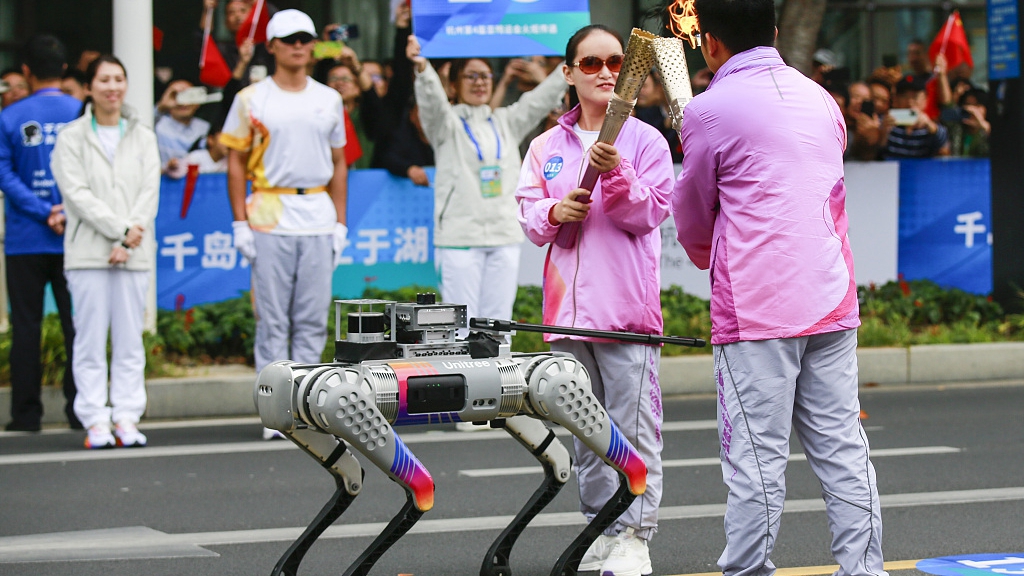
The intelligent guide dog during the torch relay of the 4th Asian Para Games in Hangzhou, Zhejiang Province, China, October 19, 2023. /CFP
The intelligent guide dog during the torch relay of the 4th Asian Para Games in Hangzhou, Zhejiang Province, China, October 19, 2023. /CFP
The Asian Para Games have long represented far more than a venue to merely tally medals. While golden feats on competition fields warrant acclaim, it is the atmosphere of empowerment and the shared ethos of progress nurtured through such means that constitute the Games' truest victories.
Sophisticated technologies unveiled in Hangzhou to enhance para-athletes' capabilities are having a great impact. From electronic identity registration codes to smart guide dogs, rehabilitation robots and facial recognition technology, these cutting-edge innovations have undoubtedly captured global attention.
The seamless integration of these technological advancements has elevated the overall experience, making it easier and more efficient for athletes to navigate the Games and enjoy their time to the fullest.
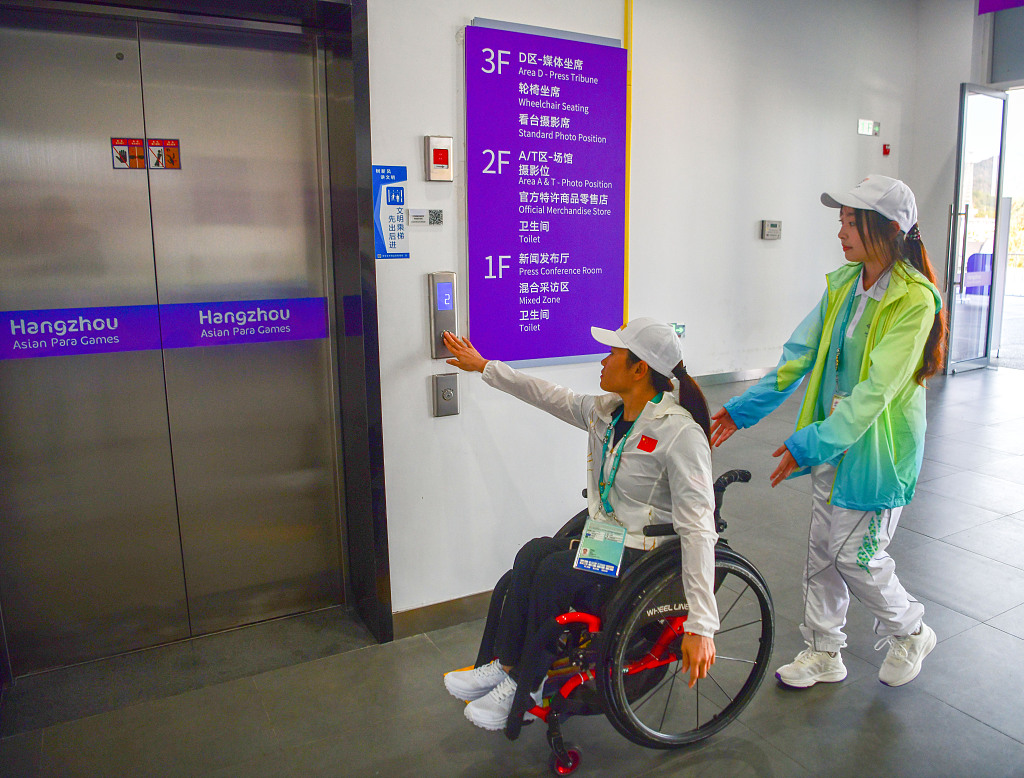
The accessible elevators are designed to cater to the needs of individuals with disabilities at the 4th Asian Para Games in Hangzhou, Zhejiang Province, China, October 24, 2023. /CFP
The accessible elevators are designed to cater to the needs of individuals with disabilities at the 4th Asian Para Games in Hangzhou, Zhejiang Province, China, October 24, 2023. /CFP
"The hardware standards of the Hangzhou Asian Para Games have truly reached an international level on par with the Paralympic Games," said Yang Jinkui, deputy secretary-general of the Chinese Sports Delegation during a press briefing on Tuesday.
"We have made significant strides in venue facilities, competition organization, service support, and compassionate care, all with a steadfast commitment to placing the athletes at the heart of it all... We are concerned that some athletes might just forget or even misplace their registration cards. Introducing electronic identity registration codes as a solution to this issue would truly be a game-changing innovation."
Yang made a special mention of the outstanding application of innovative technologies such as intelligent bionic hands, intelligent bionic legs, and intelligent guide dogs during the torch relay of the Games.
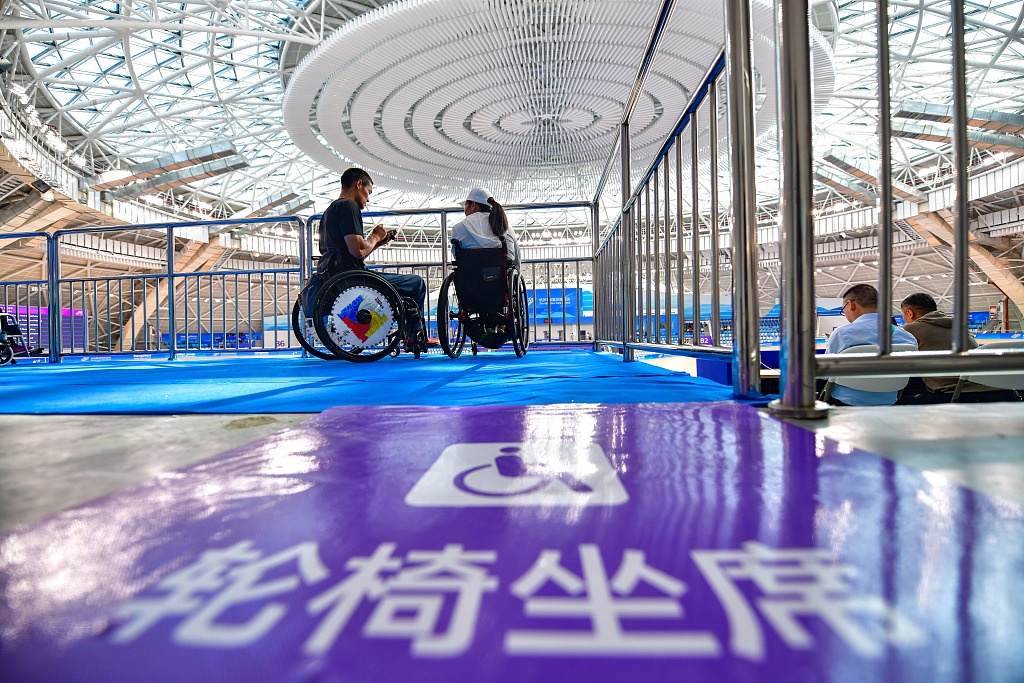
The designated wheelchair seating areas specifically for individuals with disabilities at the 4th Asian Para Games in Hangzhou, Zhejiang Province, China, October 24, 2023. /CFP
The designated wheelchair seating areas specifically for individuals with disabilities at the 4th Asian Para Games in Hangzhou, Zhejiang Province, China, October 24, 2023. /CFP
"The use of intelligent guide dogs appeared to be quite fascinating, but in reality, this application eliminates the need for visually impaired athletes to go through various procedures to bring live guide dogs with them," noted Yang.
"If organizers were to provide these intelligent guide dogs in future events, it would undoubtedly offer greater convenience to individuals with visual impairments."
The viewpoint found concurrence with Mao Genhong, chief spokesperson for the Games, who elaborated, "We have ensured that all 19 competition venues have been meticulously designed to provide fully functional, safe, and comfortable accessible environments from the entrance to various functional areas.
"Each venue is equipped with accessibility features such as accessible elevators, restrooms, and pathways. Moreover, you will find thoughtful and detailed touches throughout the venues, such as ramps and other human-centered designs that prioritize inclusivity."
If fostering an enduring legacy of inclusion emerges as China's crowning achievement, the Hangzhou Asian Para Games will endure in memory far beyond those past as a landmark of inspiration drawn from East Asia's shores.
At every party, no matter the occasion, my drink of choice is soda water with lime. I have never, not once, been drunk—or even finished a full serving of alcohol. The single time I came close to doing so (thanks to half a serving of mulled wine), my heart rate soared, the room spun, and my face turned stop-sign red … all before I collapsed in front of a college professor at an academic event.
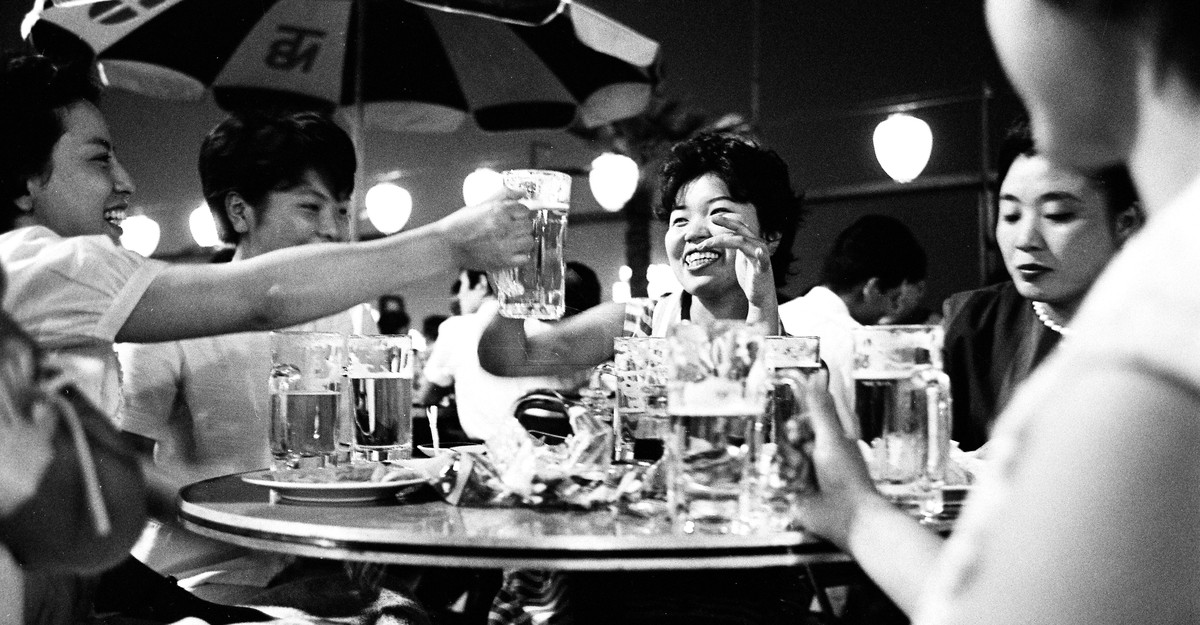
The blame for my alcohol aversion falls fully on my genetics: Like an estimated 500 million other people, most of them of East Asian descent, I carry a genetic mutation called ALDH2*2 that causes me to produce broken versions of an enzyme called aldehyde dehydrogenase 2, preventing my body from properly breaking down the toxic components of alcohol. And so, whenever I drink, all sorts of poisons known as aldehydes build up in my body—a predicament that my face announces to everyone around me.
By one line of evolutionary logic, I and the other sufferers of so-called alcohol flush (also known as Asian glow) shouldn’t exist. Alcohol isn’t the only source of aldehydes in the body. Our own cells also naturally produce the compounds, and they can wreak all sorts of havoc on our DNA and proteins if they aren’t promptly cleared. So even at baseline, flushers are toting around extra toxins, leaving them at higher risk for a host of health issues, including esophageal cancer and heart disease. And yet, somehow, our cohort of people, with its intense genetic baggage, has grown to half a billion people in potentially as littleas 2,000 years.
The reason might hew to a different line of evolutionary logic—one driven not by the dangers of aldehydes to us but by the dangers of aldehydes to some of our smallest enemies, according to Heran Darwin, a microbiologist at New York University. As Darwin and her colleagues reported at a conference last week, people with the ALDH2*2 mutation might be especially good at fighting off certain pathogens—among them the bug that causes tuberculosis, or TB, one of the greatest infectious killers in recent history.
The research, currently under review for publication at the journal Science, hasn’t yet been fully vetted by other scientists. And truly nailing TB, or any other pathogen, as the evolutionary catalyst for the rise of ALDH2*2 will likely be tough. But if infectious disease can even partly explain the staggering size of the flushing cohort—as several experts told me is likely the case—the mystery of one of the most common mutations in the human population will be one step closer to being solved.
Scientists have long been aware of aldehydes’ nasty effects on DNA and proteins; the compounds are carcinogens that literally “damage the fabric of life,” says Ketan J. Patel, a molecular biologist at the University of Oxford who studies the ALDH2*2 mutation and is reviewing the new research for publication in Science. For years, though, many researchers dismissed the chemicals as the annoying refuse of the body’s daily chores. Our bodies produce them as part of run-of-the-mill metabolism; the compounds also build up during infection or inflammation, as byproducts of some of the noxious chemicals we churn out. But then aldehydes are generally swept away by our molecular cleanup systems like so much microscopic trash.
Darwin and her colleagues are now convinced that the chemicals deserve more credit. Dosed into laboratory cultures, aldehydes can kill TB within days. In previous research, Darwin’s team also found that aldehydes—including ones produced by the bacteria themselves—can make TB ultra sensitive to nitric oxide, a defensive compound that humans produce during infections, as well as copper, a metal that destroys many microbes on contact. (For what it’s worth, the aldehydes found in our bodies after we consume alcohol don’t seem to much bother TB, Darwin told me. Drinking has actually been linked to worse outcomes with the disease.)
The team is still tabulating the many ways in which aldehydes are exerting their antimicrobial effects. But Darwin suspects that the bugs that are vulnerable to the chemicals are dying “a death by a thousand cuts,” she told me at the conference. Which makes aldehydes more than worthless waste. Maybe our ancestors’ bodies wised up to the molecules’ universally destructive powers—and began to purposefully deploy them in their defensive arsenal. “It’s the immune system capitalizing on the toxicity,” says Joshua Woodward, a microbiologist at the University of Washington who has been studying the antibacterial effects of aldehydes.
Specific cells show hints that they’ve caught on to aldehydes’ potency. Sarah Stanley, a microbiologist and an immunologist at UC Berkeley, who has been co-leading the research with Darwin, has found that when immune cells receive certain chemical signals signifying infection, they’ll ramp up some of the metabolic pathways that produce aldehydes. Those same signals, the researchers recently found, can also prompt immune cells to tamp down their levels of aldehyde dehydrogenase 2—the very aldehyde-detoxifying enzyme that the mutant gene in people like me fails to make.
If holstering that enzyme is a way for cells to up their supply of toxins and brace for inevitable attack, that could be good news for ALDH2*2 carriers, who already struggle to make enough of it. When, in an extreme imitation of human flushers, the researchers purged the ALDH2 gene from a strain of mice, then infected them with TB, they found that the rodents accumulated fewer bacteria in their lungs.
The buildup of aldehydes in the mutant mice wasn’t enough to, say, render them totally immune to TB. But even a small defensive bump can make for a massive advantage when combating such a deadly disease, Russell Vance, an immunologist at UC Berkeley who’s been collaborating with Darwin and Stanley on the project, told me. Darwin is now curious as to whether TB’s distaste for aldehyde could be leveraged during infections, she told me—by, for instance, supplementing antibiotic regimens with a side of Antabuse, a medication that blocks aldehyde dehydrogenase, mimicking the effects of ALDH2*2.
Tying those results to the existence of ALDH2*2 in half a billion people is a larger leap, several experts told me. There are clues of a relationship: Darwin and Stanley’s team found, for instance, that in a cohort from Vietnam and Singapore, people carrying the mutation were less likely to have active cases of TB—echoing patterns documented by at least one other study from Korea. But Daniela Brites, an evolutionary geneticist at the Swiss Tropical and Public Health Institute, told me that the connection still feels a little shaky. Other studies that have searched for genetic predispositions to TB, or resistance to it, she pointed out, haven’t hit on ALDH2*2—a sign that any link might be weak.
The team’s general idea could still pan out. “They are definitely on the right track,” Patel told me. Throughout most of human history, infectious diseases have been among the most dramatic influences over who lives and who dies—a pressure so immense that it’s left obvious scars on the human genome. A mutation that can cause sickle cell anemia has become very common in parts of the African continent because it helps guard people against malaria.
The story with ALDH2*2 is probably similar, Patel said. He’s confident that some infectious agent—perhaps several of them—has played a major role in keeping the mutation around. TB, with its devastating track record, could be among the candidates, but it wouldn’t have to be. A few years ago, work from Woodward’s lab showed that aldehydes can also do a number on the bacterial pathogens Staphylococcus aureus and Francisella novicida. (Darwin and Stanley’s team have now shown that mice lacking ALDH2 also fare better against the closely related Francisella tularensis.) Che-Hong Chen, a geneticist at Stanford who’s been studying ALDH2*2 for years, suspects that the culprit might not be a bacterium at all. He favors the idea that it’s, once again, malaria, acting on a different part of our genome, in a different region of the world.
Other tiny perks of ALDH2*2 may have helped the mutation proliferate. As Chen points out, it’s a pretty big disincentive to drink—and people who abstain (which, of course, isn’t all of us) do spare themselves a lot of potential liver problems. Which is another way in which the consequences of my genetic anomaly might not be so bad, even if at first flush it seems more trouble than it’s worth.
Hang Seng up 2% on China bond issue and Huijin signal
AUD hits $0.64 as inflation surprise follows hawkish RBA turn
Bitcoin roused from slumber, up 15% in three days
SINGAPORE, Oct 25 (Reuters) - China led Asia's stock markets higher on Wednesday as investors cheered the approval of a trillion-yuan sovereign bond issue as a harbinger of stimulus, while the Aussie dollar hit a two-week high as hotter-than-expected inflation lifted rate forecasts.
MSCI's broadest index of Asia-Pacific shares outside Japan (.MIAPJ0000PUS) rose 0.9% and the Hang Seng (.HSI) 2%. Japan's Nikkei (.N225) rose 1.1%.
Bonds have held onto a bounce-back after the 10-year Treasury yield breached 5% on Monday, with the benchmark yield firm at 4.82% in Tokyo trade.
Overnight solid earnings and U.S. economic data lifted Wall Street indexes, while oil and the euro had dropped on weaker-than-forecast purchasing managers surveys on the continent. U.S. and European stock futures were steady in early Asia trade.
China's top parliament approved a 1 trillion yuan ($137 billion) bond issue, state media reported adding the funds would be spent rebuilding disaster zones and improving infrastructure.
Also helping the mood was state-owned investment company Central Huijin announcing it was buying exchange-traded funds, a move which has sparked strong rallies in the past.
"Government expenditure will help the economy to stabilise further and strengthen growth in the fourth quarter," said Steven Leung, executive director of institutional sales at broker UOB Kay Hian in Hong Kong.
Central Huijin promising ETF purchases drove rallies of more than 20% in 2013 and 2015, according to UOB, and Leung said the signal had given a strong boost to sentiment.
China's blue-chip CSI300 index (.CSI300), which had been pinned near four-year lows, bounced 1%.
HIKE LOOMS DOWN UNDER
In currency markets, the euro made its steepest drop for two weeks overnight, falling 0.7% after the euro zone composite PMI fell deeper into contractionary territory to its lowest in three years.
Investors pulled forward European rate cut expectations a little and the euro was nursing losses at $1.0594.
The yen was pinned at 149.85 and the Australian dollar was the standout gainer, rising 0.6% to a two-week high of $0.64.
The annual pace of inflation in Australia slowed in the third quarter, but at 5.4% was above forecasts of 5.3%. Pricing for the odds on a rate hike next month shot to 60% from 35% before the data.
"Given the hawkish rhetoric from the RBA over the past two weeks and an uncomfortably high Q3 CPI outcome, we now expect the RBA to increase the cash rate by 25bp in November to 4.35%," ANZ analysts said in a note.
Oil fell in commodity trade on Tuesday, thanks to the weak economic data from Europe, and was nursing losses on Wednesday. Brent crude futures were steady at $88.13 a barrel, unwinding gains made in the wake of conflict in the Middle East.
"I think commodity markets are recalibrating the geopolitical implications in the Middle East ... more decisive drivers are needed for a clear direction," said Glenn Yin, head of research at AETOS Capital Group in Melbourne.
The United States and Russia were among several nations pushing for a pause in fighting between Israel and Hamas to allow aid into the besieged Gaza Strip.
After touching $1,997 an ounce last week, spot gold traded at $1,973. Bitcoin, meanwhile, seems to have awoken from long hibernation during the so-called "winter" that followed numerous scandals including the collapse of exchange FTX.
It's up 15% this week mostly thanks to speculation that exchange-traded fund applications from BlackRock and others will succeed and drive capital into the asset class. Bitcoin last bought $34,340.
The U.S. Securities and Exchange Commission has declined to comment on the speculation.
SINGAPORE, Oct 24 (Reuters) - Asian equities slipped to their lowest in more than 11 months on Tuesday, while the dollar wobbled in cautious trading ahead of a slew of economic data that will provide clues to the next steps from the U.S. Federal Reserve.
Oil prices recovered some of the previous day's losses in early Asia trade as nervousness prevailed in the market amid worries that the Israel-Hamas war could escalate into a wider conflict in the oil-exporting region.
MSCI's broadest index of Asia-Pacific shares outside Japan (.MIAPJ0000PUS) was 0.28% lower at 473.37, having touched 472.73 - the lowest since November 2022. The index is down 3% for the month and set for its third consecutive month in the red. Japan's Nikkei (.N225) fell nearly 1%.
China shares remained under pressure, with the Shanghai Composite Index (.SSEC) 0.32% higher, while Hong Kong's Hang Seng Index (.HSI) slid 0.5%.
China's blue-chip CSI300 Index (.CSI300) was 0.2% higher after closing at its lowest level in 4-1/2 years on Monday.
"The looming spectre of inflation grows even more imposing, especially considering the recent sharp ascent in oil prices," said Dalma Capital Chief Investment Officer Gary Dugan.
"If oil prices persist at this level throughout the rest of 2023 and into 2024, this could potentially inject another bout of inflation into the global economy."
Overnight, U.S. stocks wavered to a mixed close on Monday, with investors shifting their focus to this week's high profile earnings, including Microsoft (MSFT.O), Facebook-parent Meta Platforms (META.O) and Amazon (AMZN.O).
Beyond earnings, the spotlight will also be on a slate of economic data this week ahead of the Fed's meeting on Oct. 31 - Nov. 1.
The U.S. Commerce Department on Thursday will announce third-quarter gross domestic product, which is seen accelerating to 4.3%. Its wide-ranging Personal Consumption Expenditures (PCE) report, due on Friday, is expected to show annual headline and core inflation cooling down to 3.4% and 3.7%, respectively.
But before that investors will parse through the flash purchasing managers' index (PMI) data from Britain, France, the Euro zone and the United States due later on Tuesday.
The yield on the benchmark 10-year U.S. Treasury note briefly rose above 5.0% on Monday before quickly declining. In Asian hours, the yield was up 1 basis point to 4.848% on Tuesday.
The run-up in yields on the 10-year Treasury note, seen as a safe haven in times of economic uncertainty and a benchmark for borrowing costs around the world, has been driven by investors pricing in stronger U.S. growth as well as the need for more bonds to be issued to fund higher government spending.
In the currency market, the dollar was soft against a basket of currencies , having dropped 0.5% on Monday. The dollar index was 0.038% lower at 105.56.
The yen remained under pressure but found some relief due to dollar's retreat. The Japanese currency was last at 149.62 per dollar, having hit the symbolic 150 level on both Friday and Monday.
In cryptocurrencies, bitcoin was back in vogue as speculation about the possibility of a bitcoin exchange-traded fund drove enthusiasm about the sector and prompted short-sellers to exit positions.
The world's biggest cryptocurrency traded as high as $34,283, an 18-month peak, on Monday. It was last up 3% at $34,176 in Asian hours.
"There is every reason to feel the market has largely discounted a positive decision on a spot ETF," said Chris Weston, head of research at Pepperstone.
"However, as we've seen over the years there are few markets that promote FOMO (fear of missing out) and traders chasing than Bitcoin and that could drive price towards $35k and beyond."
In commodities, U.S. West Texas Intermediate crude futures rose 0.61% to $86.01 per barrel and Brent futures were at $90.41, up 0.65% on the day.
Text description provided by the architects. The project is located in the north unit of Qianjiang Century City, Hangzhou, the heart of the Asian Games Athlete Village, which is the international zone during the Asian Games. During the event, the international zone will serve as administration center, NOC (National Olympic Committee) service center, business and entertainment center, and large basic service facility (110kv substation), which is designed to be the most important public activity area in the functional composition of the Asian Games Athlete Village, and also the window for the Asian Games Athlete Village to show the image of the city to the outside. The buildings in this area should bear the main functions as supporting service facilities during the event and will be transformed into large public buildings serving the city after the Asian Games to meet the needs of urban development for culture, art, and public space.
At its inception, the project is faced with several unavoidable problems: first, how to deal with complex functions and land conditions; second, how to interpret traditional culture in modern times as a window for cultural transmission; third, how to respond to the sports theme of the Asian Games. In order to deal with these problems, the design adopts the following strategies.
One City with Six Fields - Response to Complex Conditions. The project should not only address the needs of most public activities of the Asian Games Athlete Village during the Asian Games but also take into account the functional transformation after the event. Meanwhile, the base, separated by urban roads, has urban infrastructure such as a large substation, and subway constructed almost simultaneously passing by. The designer adopts the strategy of integrating the parts into the whole, combining the sports park, subway, substation, and other infrastructure, manifesting the principle of integrated architecture and landscape design from the perspective of the city.
The building land is designed to be on the east side, and the land for the subway on the west side is mainly used for public activity space. At the same time, urban public corridors are used to connect monomers with different functions to form a coherent overall picture. As for six open spaces facing different directions in the city enclosed by corridors and four buildings, six dynamic fields are created with different themes by combining the functions of the adjacent buildings. The entire building and the site interlace each other, presenting a semi-open pattern, each site has its own special function, playing a different expression towards the city and ultimately forming the spatial characteristics of “One City with Six Fields”.
Specifically, on the north and south sides, Flag-raising Square and Gravity Square are the portals to the city. The Flag-raising Square is the place where the flag-raising ceremony of the Asian Games Athlete Village is held. It is one of the most important public spaces, clean, solemn, and magnificent. To take full account of the needs of ceremonies and events, there is also VIP access to the rooftop village courtyard and a ceremonial garden on its side. The Gravity Square is the main entrance to the north side, facing the high-speed train passing by, and will also be the main outdoor venue of the sports center.
The Tree Array Square in the middle of the site serves as the back garden of the Administration Center, which should have a certain sense of ritual, but also be relatively relaxed. On the west side, the parent-child playground, leisure field, and dynamic court are all open to the community, emphasizing public engagement. In the future, after the functional transformation, the parent-child playground will be a shared parent-child park that can be used for the city, the leisure field will be a leisure park for the elderly, the dynamic field will be a stage for young and middle-aged people, and the all-age fitness will become the theme here.
“A City Surrounded by Natural Landscape”-Interpretation of Cultural Communication. Asian Games Hangzhou is not only an international sports event, but also an important window to show Chinese culture to the world. Since ancient times, Hangzhou has had the urban pattern of “a city surrounded by natural landscape”, which has also become one of the starting points of architectural design. Inspired by Dwelling in the Fuchun Mountains and Map ofthe Imperial City of the Southern Song Dynasty, the design combines the continuous landscape with the city walls, creating a new spatial experience through architectural techniques. The design takes the abstract deduction of Dwelling in the Fuchun Mountains as the theme of the main building facades on the north and south sides, extending nearly 600 meters. Fuchun River is also representative of Jiangnan scenery around Hangzhou, which has a sense of cognition and engagement for the public and can produce rich associations.
Meanwhile, Dwelling in the Fuchun Mountains itself is representative of Chinese traditional culture, of which the two parts are separately stored on both sides of the strait. We combine them into one on the facade, which also represents a good wish. For this part of the facade, in the choice of exterior wall materials, after many experiments, turquoise pottery clay louver blades are finally used as the main materials. The facade is glazed, giving both celadon color and a feeling of jade-like warmness and smoothness. With digital design means, a complicated landscape map can be changed into four unit modules.
Dwelling in the Fuchun Mountains is abstractly deduced and completely presented with graceful angle rotation and subtleties between chromatic aberration and shade, thus showing the facade effect full of cultural characteristics of regions south of the Yangtze River. The intention of the city wall displayed by the whole base comes from the interpretation of metal bricks. The metal bricks adopt 300x1200mm module units to be staggered up and down, simulating the masonry mode of traditional bricks. Meanwhile, hollowed-out, semi-hollowed-out, and physically concentrated different unit modules are set up to form a unified and varied facade features and light and shadow effect and finally form the intention of the rhythmical city wall.
3. “People Strolling in a Painting” - Interpretation of Sports Theme. As the core of the Asian Games Athlete Village, the international zone needs to closely follow the sports theme and promote the integration of urban open space and multi-functional service space under the Chinese cultural background. Sports are taken as clues to stimulate the maximum opening of space and emphasize the importance of public engagement. As a result, a 2.0 km three-dimensional runway is created to continuously shuttle between the ground, buildings, and roofs. Combined with the creation of sports and leisure parks, the physical experience and space are fully combined to create a rich sightseeing experience.
Specific to architectural design, there are three points: First, the traveling route is used as a clue to connect the space in series, and a runway nearly two kilometers long runs through the whole site, which is closely combined with the design of the city wall. Specific to the space, taking the city wall as the carrier, various relationships between the traveling route and the wall are established under the wall, in the wall, and on the wall.
Second, continuous multi-scene creation and mutual transformation generate so-called “view changing as people walk”. According to the function and location, the scenes are set according to local conditions and connected in series with the traveling route. For example, there are a series of impressive spaces set along the way, such as magic tunnels passing through buildings, spiraling circular ramps, roof garden stations for stopovers, alleys sandwiched between city walls, large stadium screens wrapped around substations, and spectator stands embedded in buildings.
The third is the abstract deduction of the picture scroll and its relationship with cities and people. As a symbol, the picture after abstract deduction brings the dimension of time into the design, and what is hidden behind the tour is the traditional Chinese sightseeing philosophy. In the setting of the routes, people enjoy the sight of the landscape and walk into it from far to near. Visitors walk into the painting and stroll within from outside to inside. Tourists walk in the city as if they were strolling in a painting. With the principle of integrated design, the Asian Games Athlete Village creates an open attitude toward the public, hoping to reflect its own cultural aspirations and self-confidence in the process of shaping the international urban environment.