Rechercher dans ce blog

Monday, May 31, 2021

8 Easy Ways to Style High Jewelry - The Wall Street Journal

asianpostmedia.blogspot.com
Seventeen carats of emeralds and 11 carats of diamonds glow against a pristine button-down. Graff necklace, price upon request, graff.com, Prada shirt, $1,300, select Prada boutiques, Molly Goddard cardigan, $625, net-a-porter.com.

Seventeen carats of emeralds and 11 carats of diamonds glow against a pristine button-down. Graff necklace, price upon request, graff.com, Prada shirt, $1,300, select Prada boutiques, Molly Goddard cardigan, $625, net-a-porter.com.

One way to dress up a clean-cut look: Throw on dozens of diamonds. Everyday outfits, which these days may consist of sporty tees and chic sweaters, can transform into statement ensembles when styled with a few pieces of gem-laden jewelry—in this case including rare pieces from the season’s sought-after high jewelry collections. Though it may seem out of place to wear big stones with casual clothes, stylist Elizabeth Fraser-Bell demonstrates the trick is to consider the neckline, the sleeve length and the color of each garment. In some cases, the jewelry can fit in like a puzzle piece. A double-layer V-shaped necklace from Graff made of 11 carats of diamonds and 17 carats of emeralds falls effortlessly inside the lines of an unbuttoned shirt, while the round crew neck of a T-shirt frames a Bulgari Serpenti choker. 

“Don’t be afraid to go big and clash,” says Fraser-Bell, who, for this shoot with photographer David Abrahams, played with the idea of preppy dressing mixed with extra-large precious pieces. A white turtleneck and beige cardigan provides a neutral backdrop to pile on Dior’s Rose des Vents emerald and diamond layered necklace with a pair of large ball hoops and a diamond starburst ring from David Yurman. The curve of a white-gold-and-diamond Pluie de Cartier High Jewelry necklace plays off the slouchy V-neck of a cable-knit sweater. A crisp black-and-white houndstooth blazer worn with Tiffany’s gold-winged pearl earrings and Van Cleef & Arpels’s onyx and mother-of-pearl pins looks ultra modern. Lastly, if you prefer simplicity, a lone pair of diamond earrings is always a good solution. A sleek style, such as Louis Vuitton’s La Cavalière diamond-and-white-gold earrings, go well with just about anything, including bare summer skin.  —Jenny Hartman

Statement pearls and pins add polish to a black-and-white ensemble. Tiffany & Co. earrings, price upon request, select Tiffany & Co. locations, Van Cleef & Arpels brooches, rings and bracelets, prices upon request, vancleefarpel.com, Saint Laurent by Anthony Vaccarello jacket,$3,290, Saint Laurent, 3 East 57th Street, New York, Chanel cardigan, $3,500, select Chanel boutiques, Frame top, $228, frame-shop.com.

Statement pearls and pins add polish to a black-and-white ensemble. Tiffany & Co. earrings, price upon request, select Tiffany & Co. locations, Van Cleef & Arpels brooches, rings and bracelets, prices upon request, vancleefarpel.com, Saint Laurent by Anthony Vaccarello jacket,$3,290, Saint Laurent, 3 East 57th Street, New York, Chanel cardigan, $3,500, select Chanel boutiques, Frame top, $228, frame-shop.com.

The most unexpected way to wear serpent-motif diamonds is with a sporty tee. Bulgari high jewelry necklace, price upon request, bulgari.com, De Beers bracelets, $25,200 and $14,400, and ring, $11,000, De Beers, 716 Madison Avenue, New York, Gucci shirt, $650, and belted skirt, $2,100, gucci.com, Frances Austen sweater, $455, francesausten.com.

The most unexpected way to wear serpent-motif diamonds is with a sporty tee. Bulgari high jewelry necklace, price upon request, bulgari.com, De Beers bracelets, $25,200 and $14,400, and ring, $11,000, De Beers, 716 Madison Avenue, New York, Gucci shirt, $650, and belted skirt, $2,100, gucci.com, Frances Austen sweater, $455, francesausten.com.

A deceptively simple earring can be all that’s needed. Louis Vuitton high jewelry earrings, price upon request, select Louis Vuitton stores.

A deceptively simple earring can be all that’s needed. Louis Vuitton high jewelry earrings, price upon request, select Louis Vuitton stores.

Swap out go-to hoops for a dazzling diamond pair. Chopard earrings and rings, prices upon request, chopard.com, Sacai knitted shirtdress, $1,000, sacai.jp, Chanel cardigan (worn underneath), price upon request, and bag, $2,525, select Chanel boutiques.

Swap out go-to hoops for a dazzling diamond pair. Chopard earrings and rings, prices upon request, chopard.com, Sacai knitted shirtdress, $1,000, sacai.jp, Chanel cardigan (worn underneath), price upon request, and bag, $2,525, select Chanel boutiques.

Mix and match the boldest baubles for a look that’s put together. Dior fine jewelry necklace, price upon request, Dior boutiques, David Yurman earrings, $2,800, and ring, $4,800, davidyurman.com, Frances Austen cardigan (tied on shoulder) , $425, francesausten.com, and Rosetta Getty top, $325, rosettagetty.com, Dior cardigan, $2,000, Dior boutiques.

Mix and match the boldest baubles for a look that’s put together. Dior fine jewelry necklace, price upon request, Dior boutiques, David Yurman earrings, $2,800, and ring, $4,800, davidyurman.com, Frances Austen cardigan (tied on shoulder) , $425, francesausten.com, and Rosetta Getty top, $325, rosettagetty.com, Dior cardigan, $2,000, Dior boutiques.

The quickest way to dress up a cozy sweater? Add an opulent necklace made of more than 600 brilliant-cut diamonds. Cartier high jewelry necklace and earrings, prices upon request, cartier.com, Erdem sweater, $870, erdem.com.

The quickest way to dress up a cozy sweater? Add an opulent necklace made of more than 600 brilliant-cut diamonds. Cartier high jewelry necklace and earrings, prices upon request, cartier.com, Erdem sweater, $870, erdem.com.

Pile on the most personal pieces. Chanel fine jewelry earrings, $10,950, and rings, prices upon request, select Chanel boutiques, Chanel jumpsuit, $6,150, and cardigan, $4,900, select Chanel boutiques. Model, Stella Jones at Kate Moss Agency; hair, Sarah Jo Palmer; makeup, Crystabel Riley; manicure, Tinu Bello.

Pile on the most personal pieces. Chanel fine jewelry earrings, $10,950, and rings, prices upon request, select Chanel boutiques, Chanel jumpsuit, $6,150, and cardigan, $4,900, select Chanel boutiques. Model, Stella Jones at Kate Moss Agency; hair, Sarah Jo Palmer; makeup, Crystabel Riley; manicure, Tinu Bello.

Adblock test (Why?)


"8" - Google News
May 31, 2021 at 07:25PM
https://ift.tt/2SJGs80

8 Easy Ways to Style High Jewelry - The Wall Street Journal
"8" - Google News
https://ift.tt/2z1PBPz
https://ift.tt/3c1rzCJ

Asian markets fall after disappointing economic data from Japan, China - MarketWatch

Ethereum extends gains to rise 8%; bitcoin firms - Reuters

asianpostmedia.blogspot.com

A representation of virtual currency Ethereum is seen in front of a stock graph in this illustration taken February 19, 2021. REUTERS/Dado Ruvic/Illustration/File Photo

Cryptocurrency Ethereum extended gains to rise more than 8% on Monday to $2,587 but remained 40% below a record high of above $4,300 hit earlier this month.

At 1153 GMT, it was trading up 7.4% at $2,565.69.

Larger rival Bitcoin also gained in its wake with the world's biggest and best-known cryptocurrency rising 3.7% to $36,977 in quiet trading with London and U.S. markets shut for holidays.

Bitcoin has been less volatile in recent days but is down by more than 35% this month, weighed by growing regulatory pressures on the sector.

Latest positioning data for the week ended May. 25 confirmed the trend with net short positions nearly doubling from the previous week, which was the smallest net short since late March last year.

In the latest salvo against the cryptocurrency, Bank of Japan Governor Haruhiko Kuroda said much of the trading was speculative. His remarks followed China's recent efforts to crack down on mining activities. read more

It is currently trading at levels last seen in February and at roughly half its peak value of $65,000 seen in April.

Our Standards: The Thomson Reuters Trust Principles.

Adblock test (Why?)


"8" - Google News
May 31, 2021 at 07:20PM
https://ift.tt/34zGEJG

Ethereum extends gains to rise 8%; bitcoin firms - Reuters
"8" - Google News
https://ift.tt/2z1PBPz
https://ift.tt/3c1rzCJ

Section 8 renters displaced due to landlord’s accused fraud face ‘closed door after closed door’ - Dayton Daily News

asianpostmedia.blogspot.com

Our apologies, unfortunately our website is currently unavailable in most European countries due to GDPR rules.

Adblock test (Why?)


"8" - Google News
May 31, 2021 at 07:09AM
https://ift.tt/34Ch5HS

Section 8 renters displaced due to landlord’s accused fraud face ‘closed door after closed door’ - Dayton Daily News
"8" - Google News
https://ift.tt/2z1PBPz
https://ift.tt/3c1rzCJ

Opinion | 'Asian American' Is a Fiction. We Still Need It. - The New York Times

One is not born an Asian American. It’s an identity that is inherently political, and must be chosen. Before college, I had never even heard of the term, but I vividly remember the moment that I became Asian American.

I had been raised in multicultural San Jose, Calif., during the late 1970s and 1980s, among Mexican Americans and working-class white people. My family and I were refugees from Vietnam and the war fought there, but all I knew of the history that had brought us and many of our neighbors to the United States was what Hollywood told me. It confused me and shamed me to see people who looked like my parents being reduced to wordless masses, condemned to be killed, raped, rescued or silenced.

When my parents talked about Americans, they meant other people, not us, but I felt American, as well as Vietnamese. My parents could use “Oriental” without self-consciousness, but I could not. Something struck me as wrong about that word, but I didn’t know what it was until I studied Asian American history and literature at the University of California, Berkeley. There I learned about the Chinese Exclusion Act, the internment of Japanese Americans, the colonization of the Philippines, the annexation of Hawaii, the often forgotten presence of Korean and Indian immigrants in the early 20th century, the signs that said “No Dogs or Filipinos Allowed,” and the experiences of Vietnamese, Cambodian, Laotian and Hmong people during and after the Indochina wars.

That’s when I became Asian American. And the overwhelming emotion that I felt on learning this history was rage. Muhammad Ali said that “writing is fighting” — and I wanted to write and fight, especially after I discovered that Asian Americans had been writing and fighting in English since the late 19th century: the sisters Sui Sin Far and Onoto Watanna, Carlos Bulosan, John Okada, Frank Chin, Maxine Hong Kingston and many more.

I hadn’t learned about them before because racism isolates us, disempowers us, and erases our history. One solution is to find others and discover strength in our stories and our numbers. In high school, my Asian friends and I jokingly called ourselves “the Asian invasion” because that was all the language we had. In college, I joined the Asian American Political Alliance. There I learned that the term “Asian American” had been invented in California by Yuji Ichioka and Emma Gee when they formed the Asian American Political Alliance in 1968 at U.C. Berkeley.

“Asian American” was a creation — and those who say that there are no “Asians” in Asia are right. But neither is there an “Orient” or “Orientals” — those fantastic figments of the Western imagination, as Edward Said argued. Against this racist and sexist fiction of the Oriental, we built the anti-racist, anti-sexist fiction of the Asian American. We willed ourselves into being, but as with every other act of American self-conjuring, we became marked by a contradiction between American aspiration and American reality.

On the one hand, Asian Americans have long insisted that we are patriotic and productive Americans. This self-defense often leans upon the “model minority” myth, and the idea that Asian Americans have succeeded in fields such as medicine and technology because we immigrated with educational credentials, and we raise our children to work hard. But Asian Americans are also haunting reminders of wars that killed millions and generated many refugees. And Asian Americans have come to satisfy the American need for cheap, exploitable labor — from working on railroads to giving pedicures. We were and are perceived to be competitors in a capitalist economy fractured by divisions of race, gender and class, and the ever-widening gap of inequality that affects all Americans.

These roles that we play, and the contradictions they represent, aren’t going anywhere. So long as the United States remains committed to aggressive capitalism domestically and aggressive militarism internationally, Asians and Asian Americans will continue to be scapegoats who embody threat and aspiration, an inhuman “yellow peril,” and a superhuman model minority.

No claim to American belonging will end the vulnerability of Asian Americans to racism and cyclical convulsions of violence. And what does it even mean to claim belonging in the United States? If we belong to this country, then this country belongs to us, every part of it, including its systemic anti-Black racism and its colonization of Indigenous peoples and land. Like wave after wave of newcomers to this country before, Asian immigrants and refugees learned that absorbing and repeating anti-Black racism helps in the assimilation process. And like the European settlers, Asian immigrants and refugees aspire to the American dream, whose narrative of self-reliance, success and property accumulation is built upon the theft of land from Indigenous peoples.

“Asian American” has now morphed into a newer fiction: the “Asian American and Pacific Islander” community, or A.A.P.I. But again, there are contradictions inherent to this identity. Pacific Islanders — Hawaiians, Samoans, the Chamorro of Guam — have been and remain colonized by the United States, with Hawaii and Guam serving as major American military bases that project power in the Pacific and Asia. “A.A.P.I.” is a staple of the lofty rhetoric and pragmatic corporate language of diversity and inclusion, but it also tends to gloss over the United States’ long history of violence and conquest. It’s not only railroads and internment that are central to A.A.P.I. experience; so is the colonization of Hawaii, masked by the tourist fantasy of an island paradise.

Now we applaud the success stories of Asian American billionaires, politicians, movie stars, and “influencers,” and the popularity of our cultural commodities, from boba to BTS. We raise each other up through networking — in the hope that embracing global capitalism, the idea of meritocracy and corporate culture will make us belong in the United States. But belonging will only get us so far, for belonging always involves exclusion.

We should look to other ideals: solidarity, unity and decolonization. Colonization and racism divide and conquer, telling the subjugated that they have nothing in common. That’s why unity is crucial, and a broader unity can grow from the solidarity we have expressed with one another as Asian Americans, the force that pulled together such disparate peoples and experiences. That will to find kinship can be the basis for further solidarities — with everyone else shaped by colonization’s global impact, its genocide and slavery, racism and capitalism, patriarchy and heteronormativity.

This is the only way that an Asian American-Pacific Islander coalition makes sense — pointing the way toward alliances with other groups, from Black Americans to Muslims, Latinos to L.G.B.T.Q. people. Asian Americans are one political identity among the many that must come together for decolonization.

Viet Thanh Nguyen (@viet_t_nguyen) is the author of the novels “The Sympathizer” and its sequel, “The Committed.” He is a professor of English, American studies and comparative literature at the University of Southern California.

The Times is committed to publishing a diversity of letters to the editor. We’d like to hear what you think about this or any of our articles. Here are some tips. And here’s our email: letters@nytimes.com.

Follow The New York Times Opinion section on Facebook, Twitter (@NYTopinion) and Instagram.

Adblock test (Why?)


"asian" - Google News
May 31, 2021 at 04:00PM
https://ift.tt/3c5LFhi

Opinion | 'Asian American' Is a Fiction. We Still Need It. - The New York Times
"asian" - Google News
https://ift.tt/2STmru2
Shoes Man Tutorial
Pos News Update
Meme Update
Korean Entertainment News
Japan News Update

Team Liquid wins FURIA rematch to win grand final of cs_summit 8 - Reuters

asianpostmedia.blogspot.com

In a much-anticipated rematch of a thrilling upper-bracket final two days earlier, Team Liquid closed the cs_summit 8 tournament by winning Sunday’s grand final over FURIA Esports.

Liquid won the best-of-five final 3-1 to claim the first-place prize pool of $17,000 and 1,600 North American Regional Major Rankings points. In defeat, FURIA earned $10,000 and 1,500 points as the runners-up.

On Friday, fans were treated to an epic match that saw the first two maps go to overtime, with the third won by Liquid 16-14 after they almost blew a 14-7 lead.

Sunday the two squads battled to a fourth map in a best-of-five. After trailing the first map early, Liquid stunned FURIA with a 22-1 blitz -- a first-map 13-1 finishing run to take Overpass 16-7 and a quick 9-0 lead on Nuke before allowing a point, leading to a 16-11 edge to go up 2-0.

FURIA seemed primed to be swept after falling behind 14-9 on Inferno before an inspiring seven-point surge gave them a 16-14 decision. But Liquid ended all comeback hopes, crushing FURIA 16-5 on Mirage to clinch the title.

American Jonathan “EliGE” Jablonowski topped all scorers with 81 kills while Liquid teammate Keith “NAF” Markovic of Canada posted a match-best plus-27 kills-deaths differential. Brazil’s Kaike “KSCERATO” Cerato led the way for FURIA with 69 kills.

The $50,000 Counter-Strike: Global Offensive event began with eight teams divided into two double-elimination groups.

The top two teams in each group advanced to the upper bracket of the double-elimination playoffs, while the two third-place teams entered the playoffs’ lower bracket. The two fourth-place teams were eliminated.

cs_summit 8 prize pool and North American Regional Major Rankings, plus points distribution:

1. $17,000, 1,600 points -- Team Liquid

2. $10,000, 1,500 points -- FURIA Esports

3. $7,000, 1,400 points -- EXTREMUM

4. $5,000, 1,300 points - O Plano

5. $4,000, 1,200 points -- Extra Salt

6. $3,000, 1,100 points - paiN Gaming

7-8. $2,000, 950 points -- Evil Geniuses, Bad News Bears

--Field Level Media

Adblock test (Why?)


"8" - Google News
May 31, 2021 at 11:54AM
https://ift.tt/34LkuEJ

Team Liquid wins FURIA rematch to win grand final of cs_summit 8 - Reuters
"8" - Google News
https://ift.tt/2z1PBPz
https://ift.tt/3c1rzCJ

Most US schools teach little to nothing about Asian American history and it hurts everyone, experts say - CNN

"Mommy, why do we not learn about Asian American history? Why are other ones more important?" the elementary student asked Kim, an associate professor of elementary and early childhood education at Kennesaw University. "Why are other people more respected?
About 22.9 million people in the US identify as having Asian heritage, according to the US Census. Yet, in many schools across the US, if Asian Americans and Pacific Islanders are mentioned in social studies and history lessons at all, they boil down to brief lines describing primarily two topics: immigration and Pearl Harbor.
"School curriculum is missing AAPI stories that are needed to build up who they are as American citizens," said Kim.
Experts say this gap in representation has severe impacts on Asian students, who don't see themselves woven into the tapestry of US history, and for non-Asian students who are not taught to value the contributions of communities with which they do not identify.
Now there is a fresh drive from teachers, organizations and legislators -- motivated by a surge in anti-Asian hate crimes as well as the celebration of AAPI Heritage Month -- to bring more nuanced, representative Asian American history to classrooms.
This year, partially prompted by the mass shooting in the Atlanta area that left six Asian women dead, fifth-grade teacher Lisa Chu wanted to expand her students' understanding of AAPI history.
But the single detail in the curriculum that covered Asian history only described Asian immigrants coming in through Angel Island in San Francisco instead of Ellis Island through which European immigrants came in, and she turned it into an experiential learning moment.
She discussed the different treatment of Asian immigrants, how they were held for weeks at the port while European immigrants were often held for only hours. She and her students discussed what it was like to be subjected to embarrassing, invasive questioning. They talked about how that treatment was rooted in racism, a sentiment that has not gone away.
"I think as this generation continues to get older, the more aware they are the more powerful they have to actually cause change," said Chu, who teaches in Gwinnett County, Georgia.
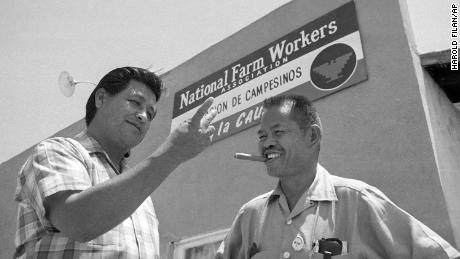
Larry Itliong, right, a Filipino-American labor leader and organizer with United Farm Workers leader Cesar Chavez, left, in front of union headquarters.

"My country doesn't treat me as a somebody"

Education researchers say that denying AAPI students education about their own history not only inhibits their knowledge, it is detrimental to their identity as Americans.
Sohyun An, a professor of elementary and early childhood education at Kennesaw University in Georgia, has researched AAPI history education across ten states including, Georgia, California, New Jersey and Texas. She found that if there was any mention of Asian American history, it was mostly limited to the internment of Japanese Americans during World War II and Chinese immigration and their participation in building railroads.
Although people of Asian descent have been part of the fabric of the US since its early days, that isn't taught to students, she said. Instead, the lessons teach that Asian Americans are perpetual foreigners, according to An.
When An's daughter learned about the American Revolution, she came to her mother asking if she would have been a slave in those times. She couldn't figure out where she fit in, she said.
Kim's children came to her with similar questions.
"Mommy, what color is my skin? I think that I'm not White, and I'm not Black and also I'm not Brown," they asked.
"If we don't teach about Asian American history, it's not only letting non-Asian people to treat us as non-humans, but it is also a curriculum of violence because it kills humanity and agency," An said. "My country doesn't treat me as a somebody."
Kiana Kenmotsu was in the sixth grade when she first read about her own history in school.
It was one story about the internment of Japanese Americans, a wrong suffered by her grandfather, but now 18-year-old Kenmotsu said it changed everything for her.
"Every time (Asian history) was brought up, I felt a high," she said. " History is something you connect with. I was never able to connect with it."
That crucial identity formation that is offered through learning history can be especially complicated for Asian American students because their individual experiences under many nationalities often get lumped together under one Asian identity, said Sarah-SoonLing Blackburn with the Learning for Justice, an organization founded by the Southern Poverty Law Center.
Or educators get too overwhelmed to touch the topic at all. "For Asian American students, it erases your own understanding of yourself," Blackburn said.
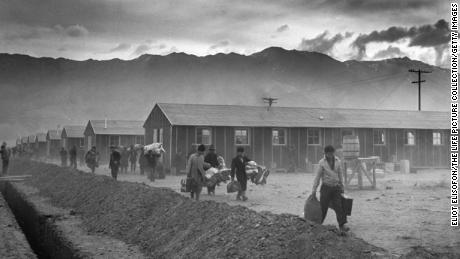
The first group of 82 Japanese-Americans arrive at the Manzanar internment camp (or 'War Relocation Center') carrying their belongings in suitcases and bags in 1942.

Stereotypes keeping people divided

But the impacts go beyond those who identify as Asian.
Five years after Kenmotsu's first encounter with Asian American history, a class in her school held a trial over the morality of internment during World War II and the verdict reached was that the US was right to detain residents the students found to be a threat.
Kenmotsu said she couldn't look her classmates in the eye afterward, feeling they did not have the knowledge to empathize with and value the trauma inflicted on her family throughout history.
When the history that is taught in the classroom is representative of all American populations, it teaches students that the US belongs to the many groups -- not just the European immigrants represented in most of their textbooks, An said. Understanding other cultures and seeing their importance encourages compassion and fights the stereotype of immigrants as dangerous, she said.
Chu said she noticed that Asian history only comes up when an Asian population did something dangerous or when the event has been sugar-coated. It is much less common to hear in a classroom about contributions Asian Americans have made to the nation.
It can also be seen as unpatriotic to talk about the harm the US has inflicted on groups of people, Blackburn said.
Without a rich understanding of how Asian Americans have been discriminated against and been central to the American system, some students are left only with stereotypes to fill in their understanding, researchers said.
The model minority, the economic competitors and the foreigners ordered to go back to their country -- even if their families have been in the US for generations --- are common roles Asian Americans are cast in during times of crisis, An said.
"Stereotypes erase individuals," Blackburn said. And without individual power, Asian Americans are stripped of their collective power, which can be used to fight for their own interest as well as in alliance with other minority groups, she said.
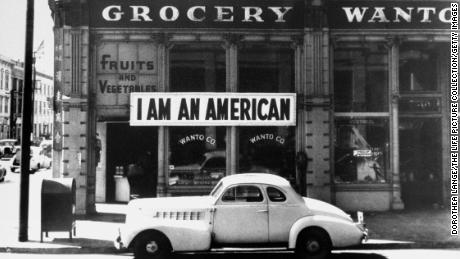
A sign reading: 'I AM AN AMERICAN', on the Wanto Co grocery store in Oakland, California, the day after the attack on Pearl Harbor, 8th December 1941.

Legislation and calls for action

Blackburn and organizations like Learning for Justice hope to equip teachers to make their classrooms more equitable and their curriculum more representative, but others are pushing for legislation to implement change.
Asian Americans Advancing Justice Chicago worked with State Senator Ram Villivalam and Rep. Jennifer Gong-Gershowitz to introduce the Teaching Equitable Asian American Community History (TEAACH) Act in Illinois.
The legislation, which has passed the state house and senate and is going back to the house for a concurrence vote, would amend the Illinois School Code to mandate Asian American history be taught in every public school.
"I didn't see our community in our textbooks, and it was hard to understand who our community was in relation to everyone else," Villivalam said. "For Asian American students it will be a chance to learn our history, the contributions our community has made."
While Chu said she thinks it is important to expand students' learning, she has questions about whether legislation to make additions to the curriculum is the way to accomplish that.
"I think the idea is great, but I think people forget that social studies is already on the backburner of almost every single teacher," Chu said. With so much already on teachers' backs and reading and math given priority for state testing, if anything gets short changed, it's social studies, she added.
Rather than adding units in a lesson plan, Chu said she hopes state boards of educations and districts change their standards. And, she added, that teachers will choose to go deeper in their own classrooms.
"Embed it without it becoming its own separate unit on its own," Chu said.
Otherwise, she feels that AAPI will be seen as a separate entity "rather than we are a part of American history."

Adblock test (Why?)


"asian" - Google News
May 31, 2021 at 11:41AM
https://ift.tt/3yRDaAc

Most US schools teach little to nothing about Asian American history and it hurts everyone, experts say - CNN
"asian" - Google News
https://ift.tt/2STmru2
Shoes Man Tutorial
Pos News Update
Meme Update
Korean Entertainment News
Japan News Update

Search

Featured Post

Rubin Museum, Haven for Asian Art, to Close After 20 Years - The New York Times

It is the first major art museum in New York to close within recent memory. The museum had financial challenges and has faced accusations o...

Postingan Populer