Rechercher dans ce blog

Tuesday, June 7, 2022

Asian Markets Mixed After Wall St Bond Sell-Off - U.S. News & World Report

[unable to retrieve full-text content]

Asian Markets Mixed After Wall St Bond Sell-Off  U.S. News & World ReportView Full Coverage on Google News

"asian" - Google News
June 07, 2022 at 11:51AM
https://ift.tt/P9lVw7C

Asian Markets Mixed After Wall St Bond Sell-Off - U.S. News & World Report
"asian" - Google News
https://ift.tt/vkw1PNS
Shoes Man Tutorial
Pos News Update
Meme Update
Korean Entertainment News
Japan News Update

The race toward a new computing technology is heating up — and Asia is jumping on the trend - CNBC

In this article

A quantum computer in a vibration-free building. Quantum computing will ultimately speed up the computational power that drives many industries and could affect everything from drug discovery to how data is secured.
Oliver Berg | Picture Alliance | Getty Images

Quantum computing was already gathering pace in Japan and elsewhere in Asia when the University of Tokyo and IBM launched their new quantum computer last year.

The computer was the second such system built outside the United States by IBM — the latest in a string of key moves in quantum research.

The university and IBM have led the Quantum Innovation Initiative Consortium alongside heavyweights of Japanese industry like Toyota and Sony — all with a view to nailing the quantum question.

Quantum computing refers to the use of quantum mechanics to run calculations. Quantum computing can run multiple processes at once by using quantum bits, unlike binary bits which power traditional computing.

Challenging U.S. 'hegemony'

The new technology will ultimately speed up the computational power that drives many industries and could affect everything from drug discovery to how data is secured. Several countries are racing to get quantum computers fully operational.

Christopher Savoie, CEO of quantum computing firm Zapata, who spent much of his career in Japan, said technological development has been very U.S.-centric. But now, Asian nations don't want to be left behind on quantum computing, he added.

"Nation states like India, Japan and China are very much interested in not being the only folks without a capability there. They don't want to see the kind of hegemony that's arisen where the large cloud aggregators by and large are only US companies," Savoie said, referring to the likes of Amazon Web Services and Microsoft Azure.

China, for example, has committed a great deal of brainpower to the quantum race. Researchers have touted breakthroughs and debates are simmering over whether China has surpassed the U.S. on some fronts.

India, for its part, announced plans earlier this year to invest $1 billion in a five-year plan to develop a quantum computer in the country.

James Sanders, an analyst at S&P Global Market Intelligence, told CNBC that governments around the world have been taking more interest in quantum computing in recent years.

In March, Sanders published a report that found governments have pledged around $4.2 billion to support quantum research. Some notable examples include South Korea's $40 million investment in the field and Singapore's Ministry of Education's funding of a research center, The Center for Quantum Technologies.

Where will it be used?

All of these efforts have a long lens on the future. And for some, the benefits of quantum can seem nebulous.

According to Sanders, the benefits of quantum computing aren't going to be immediately evident for everyday consumers.

What is likely to happen is that quantum computers will wind up utilized in designing products that consumers eventually buy.
James Sanders
analyst, S&P Global Market Intelligence

"On a bad day, I'm talking people down from the idea of quantum cell phones. That's not realistic, that's not going to be a thing," he said.

"What is likely to happen is that quantum computers will wind up utilized in designing products that consumers eventually buy."

There are two major areas where quantum's breakthrough will be felt — industry and defense.

A staff member of tech company Q.ant puts a chip for quantum computing in a test station in Stuttgart, Germany, on Sept. 14, 2021. It's expected that the power of quantum computing will be able to decrypt RSA encryption, one of the most common encryption methods for securing data.
Thomas Kienzle | Afp | Getty Images

"Areas where you have HPC [high-performance computing] are areas where we will be seeing quantum computers having an impact. It's things like material simulation, aerodynamic simulation, these kinds of things, very high, difficult computational problems, and then machine learning artificial intelligence," Savoie said.

In pharmaceuticals, traditional systems for calculating the behavior of drug molecules can be time-consuming. The speed of quantum computing could rapidly increase these processes around drug discovery and, ultimately, the timeline for drugs coming to market.

Security challenges

On the flip side, quantum could present security challenges. As computing power advances, so too does the risk to existing security methods.

"The longer-term [motivation] but the one that that everyone recognizes as an existential threat, both offensively and defensively, is the cryptography area. RSA will be eventually compromised by this," Savoie added.

RSA refers to one of the most common encryption methods for securing data, developed in 1977, that could be upended by quantum's speed. It is named after its inventors — Ron Rivest, Adi Shamir and Leonard Adleman.

You're seeing a lot of interest from governments and communities that don't want to be the last people on the block to have that technology because [other nations] will be able to decrypt our messages.
Christopher Savoie
CEO of Zapata

"You're seeing a lot of interest from governments and communities that don't want to be the last people on the block to have that technology because [other nations] will be able to decrypt our messages," Savoie said.

Magda Lilia Chelly, chief information security officer at Singaporean cybersecurity firm Responsible Cyber, told CNBC that there needs to be a twin track of encryption and quantum research and development so that security isn't outpaced.

"Some experts believe that quantum computers will eventually be able to break all forms of encryption, while others believe that new and more sophisticated forms of encryption will be developed that cannot be broken by quantum computers," Chelly said.

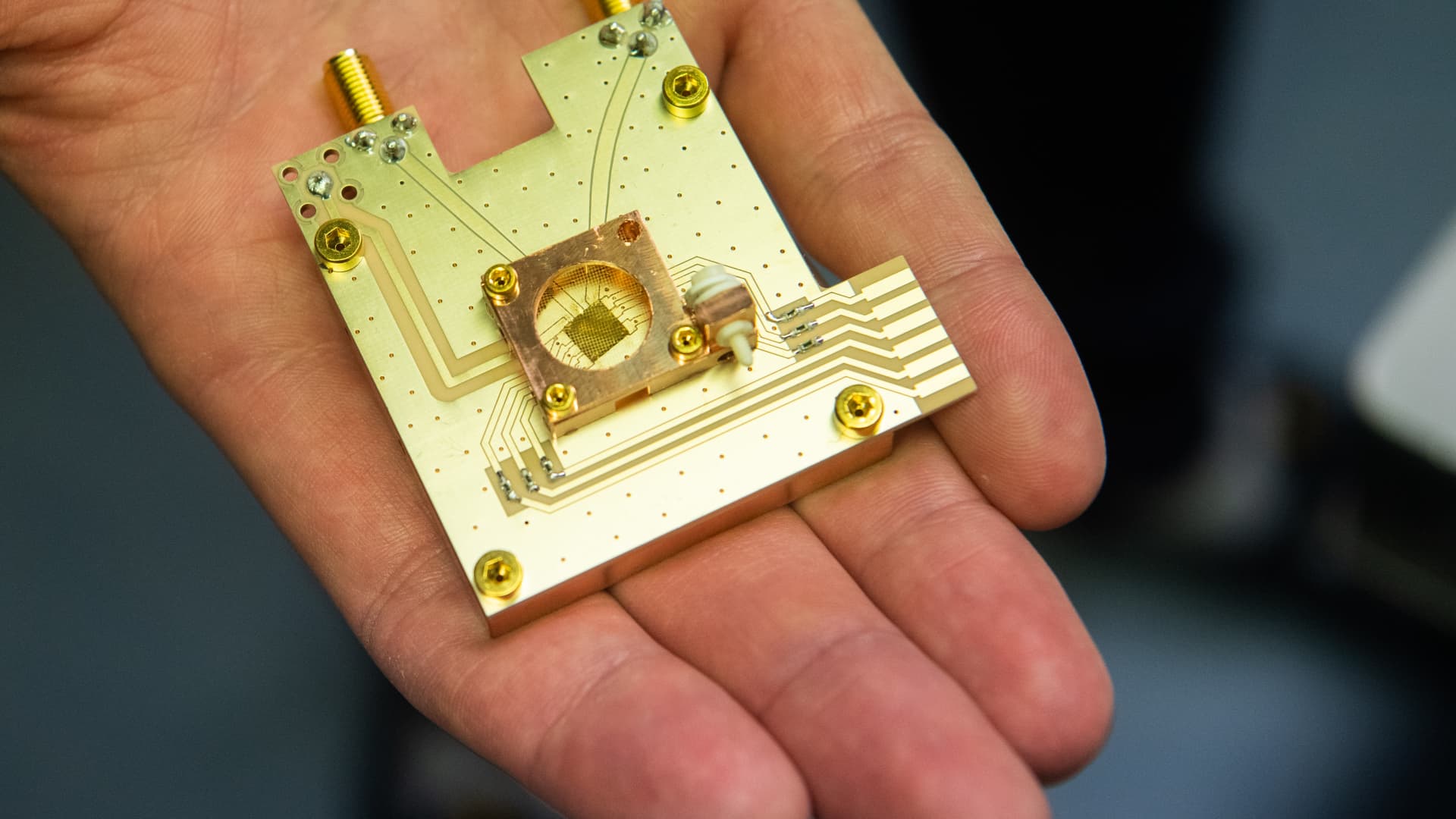
A quantum processor on a prototype of a quantum computer. There needs to be a twin track of encryption and quantum research and development so that security isn't outpaced, said Magda Lilia Chelly, chief information security officer at Singaporean cybersecurity firm Responsible Cyber.
Julian Stratenschulte/dpa | Picture Alliance | Getty Images

"In particular, [researchers] have been looking at ways to use quantum computers to factor large numbers quickly. This is important because many of the modern encryption schemes used today rely on the fact that it is very difficult to factor large numbers," she added.

If successful, this would make it possible to break most current encryption schemes, making it possible to unlock messages that are encrypted.

'Stop-start' progress

Sanders said the development and eventual commercialization of quantum computing will not be a straight line.

Issues like the threat to encryption can garner attention from governments, but research and breakthroughs, as well as mainstream interest, can be "stop-start," he said.

Progress can also be affected by fluctuating interest of private investors as quantum computing won't deliver a quick return on investment.

"There are a lot of situations in this industry where you might have a lead for a week and then another company will come out with another type of the advancement and then everything will go quiet for a little bit."

Another looming challenge for quantum research is finding the right talent with specific skills for this research.

"Quantum scientists that can do quantum computing don't grow on trees," Savoie said, adding that cross-border collaboration is necessary in the face of competing government interests.

"Talent is global. People don't get to choose what country they're born in or what nationality they have."

Adblock test (Why?)


"asian" - Google News
June 07, 2022 at 07:57AM
https://ift.tt/YloiStH

The race toward a new computing technology is heating up — and Asia is jumping on the trend - CNBC
"asian" - Google News
https://ift.tt/vkw1PNS
Shoes Man Tutorial
Pos News Update
Meme Update
Korean Entertainment News
Japan News Update

Monday, June 6, 2022

Asian Stocks Rise as Survey Shows Chinese Services Reviving - U.S. News & World Report

[unable to retrieve full-text content]

Asian Stocks Rise as Survey Shows Chinese Services Reviving  U.S. News & World ReportView Full Coverage on Google News

"asian" - Google News
June 06, 2022 at 11:33AM
https://ift.tt/Y5ARH4y

Asian Stocks Rise as Survey Shows Chinese Services Reviving - U.S. News & World Report
"asian" - Google News
https://ift.tt/JcVa2Yl
Shoes Man Tutorial
Pos News Update
Meme Update
Korean Entertainment News
Japan News Update

Sunday, June 5, 2022

San Francisco Democrats squandering gains with Asian Americans - San Francisco Chronicle

As a progressive and a Democrat, I want to share a warning with the party that I have belonged to my entire voting life: The recall election of San Francisco District Attorney Chesa Boudin — just like the successful recall of three San Francisco school board commissioners in February — is no fluke.

It’s a shift.

Whether we see the evidence of this shift in the results of Boudin’s recall, the November midterms or the 2024 presidential election, it’s essential to take note: Democrats are squandering their hard-won gains with Asian Americans.

In October, I delivered a demand letter to Boudin on behalf of the California Asian Pacific American Bar Association and eight other Asian American advocacy organizations. The letter expressed concern that the Boudin was not devoting sufficient resources to Asian American victims and their families. We demanded timely communication with victims of apparent anti-Asian hate and an explanation of what Boudin was doing to protect members of the Asian American community. After the letter, we met with Boudin twice. Without disclosing the substance of the discussions, I will say I felt frustrated and let down — talked at, rather than listened to.

The problem of Asian Americans being talked at by progressive Democrats, however, is bigger than just one district attorney.

It’s taken many years of effort for Democrats to win over Asian American voters. In 1992, exit polls showed Asian Americans favored Republican George H.W. Bush to Bill Clinton 55% to 31% (with many voting for the third party candidate). The tide turned in 2000, when Democrat Al Gore won the Asian American vote 54% to 41%. In the two most recent presidential elections, Asian Americans favored Hillary Clinton over Trump by 65% to 27% and chose Biden over Trump by a whopping 68% to 29%.

So why the concern now?

This year, I’ve helped organize three national rallies for Asian Americans. The events were memorials to the many recent Asian American victims of violence, like San Francisco’s Vicha Ratanapakdee, whose killing sparked an anti-Asian hate movement. This effort provided me a unique opportunity to speak with community members from around the country.

Asian Americans are not a monolithic group, but it wasn’t hard for me to observe a trend — many in the community feel unheard. They believe that today’s political discourse does not represent Asian American viewpoints, or worse, delegitimizes their experiences and excludes them.

One major fissure is the debate over policing and violence prevention. Most Asian Americans live in fear of violence. An April 2022 Pew Research survey showed that 63% of Asian Americans say violence against Asians is increasing, and 72% worry that they will be threatened or attacked because of their race. Of those, over a third changed their daily routines over the concern.

Seventy-five percent of Asian Americans supported the Black Lives Matter movement, according to Pew. Like the vast majority of Americans, Asian Americans favor common sense criminal justice reforms. But they do not support extreme proposals like defunding the police. While some Democratic leaders have distanced themselves from the slogan, others continue to advocate for abolition.

To be clear, this is not where Asian Americans are: The 2022 Pew survey showed that nearly half of Asian American adults say strengthening laws against hate crimes would be the most effective in preventing violence against Asian Americans, with an additional 14% favoring increasing local police presence as the most effective measure. In other words, nearly two-thirds (62%) believe that a criminal law approach is the most effective means of preventing violence against the community.

After the 2020 presidential election, Democrats reacted with alarm when support for Trump among Latinx voters grew dramatically. Faced with the choice of a repugnant president, the erosion of Asian American support did not yet manifest. In fact, record turnout by Asian Americans in Georgia helped deliver the presidency and the Senate to the Democrats.

Since 2020, however, there has been a subterranean shift. In the 2021 New York City mayoral election, Eric Adams handily defeated GOP candidate Curtis Sliwa. But Democrats were surprised that in majority-Asian American precincts, the GOP candidate exceeded expectations. Then in February, high Asian American turnout drove the removal of three progressive members of the San Francisco Board of Education in a historic, landslide vote.

This trend shift may be subtle, but it is real.

Democrats like Boudin must awaken to it before it’s too late. Asian American voters remain supportive of many Democratic policy positions. But they believe that progressives do not weigh their concerns equally, either ignoring Asian American experiences altogether or treating them as inconvenient.

Asian Americans are the fastest growing demographic in the United States. Their vote has proved decisive. No matter Boudin’s fate in Tuesday’s election, it’s time for Democrats to pay attention — and actually listen — to Asian Americans.

Charles H. Jung is an attorney and serves as executive director of the California Asian Pacific American Bar Association. He wrote this piece in his personal capacity.

Adblock test (Why?)


"asian" - Google News
June 05, 2022 at 06:03PM
https://ift.tt/opqXdRl

San Francisco Democrats squandering gains with Asian Americans - San Francisco Chronicle
"asian" - Google News
https://ift.tt/JcVa2Yl
Shoes Man Tutorial
Pos News Update
Meme Update
Korean Entertainment News
Japan News Update

Asian Americans are typecast as successful students, but new report finds troubling gaps - Lowell Sun

LOS ANGELES — Asian Americans are often seen as successful students, but the stereotype masks “incredibly disconcerting” gaps in college outcomes among the multiple ethnic groups who make up the larger community in California, according to a new report released Tuesday.

Among the first-year, full-time students who entered the University of California in 2013, six-year graduation rates vary from about 90% for those of Chinese, Vietnamese and Indian descent to about 70% for Samoans and Hmong undergraduates, according to the report by the Campaign for College Opportunity. At California State University, about 85% of transfer students of Japanese and Filipino ancestry graduate in four years compared with less than 70% for Native Hawaiian, Bangladeshi and Tongan students.

The 95-page report details other stark differences in academic achievement among California’s Asian American and Pacific Islander subgroups, including qualification for UC and Cal State admission, completion of community college degree or certificate programs and attainment of bachelor’s degrees. Data on 30 subgroups were examined.

“The Asian American community in California is incredibly diverse and there are huge differences in terms of college preparation, college going and college success,” said Michele Siqueiros, president of the college advocacy organization. “It’s really harmful to lump all of the groups into a broad Asian American category together when we know that sort of model minority myth is absolutely harmful for subgroups that are not getting the kind of support or experiencing the kind of success … that some groups are experiencing.”

California is home to about 6.8 million Asian Americans, the largest concentration in the nation, and about 332,000 Native Hawaiian and Pacific Islanders. The vast majority trace their heritage to China, the Philippines, India, Vietnam, Korea and Japan, but dozens of other groups also reside in the state. All told, they make up about 15% of the state’s population, the second largest racial/ethnic minority after Latinos.

The report notes some bright spots: 59% of Asian Americans between the ages of 25 and 64 have bachelor’s degrees, the state’s highest rate among racial or ethnic groups. Their overall six-year graduation rate of 88% is the highest in the UC system, and their enrollment at UC and Cal State held steady between 2019 and 2021, despite the COVID-19 pandemic.

But there was also disconcerting news: Only 22% of Native Hawaiian or Pacific Islander Californians have bachelor’s degrees, one of the lowest rates in the state. And, although 82% of Hawaiian and Pacific Islander Californians who entered high school in 2017 graduated, less than half completed the college prep coursework required for UC and Cal State admission.

The report highlighted other nuances masked by lumping all Asian, Native Hawaiian and Pacific Islander Americans into one category. In 2020, nearly half of Cal State first-year students from that broad community reported incomes low enough to receive a federal Pell Grant, a smaller proportion than the systemwide average of 59%. But the rate varied dramatically by subgroup, from 11% for students of Japanese ancestry to 80% for Hmong Californians.

The broad community shared common struggles, however, particularly during the COVID-19 pandemic. Anti-Asian hate surged, small businesses shut down at disproportionately high rates, long-term unemployment rates rose, and Native Hawaiian and Pacific Islander residents had the highest rates of COVID-19 infections and related deaths among all racial and ethnic groups in the state.

The myriad stresses affected students. Leila Tamale said financial instability triggered by the pandemic drove her to save money by attending a community college instead of a four-year university. But she ultimately thrived at the College of San Mateo, she said, after joining a learning community there designed for Pacific Islander students like her — called Mana — that provides academic support, personal development and cultural connections.

Such targeted programs are critical to boost the success of the community’s underserved subgroups, Tamale said Tuesday at a Campaign for College Opportunity webinar.

The failure to recognize the various challenges faced by subgroups has led to an assumption that they have few problems and to their “invisibility” in many equity conversations, Siqueiros said.

The report notes, for instance, that Asian American and Native Hawaiian/Pacific Islander faculty members are underrepresented compared with white counterparts in all three of the state’s public higher education systems. Yet a current UC initiative to diversify the faculty is focusing on Black, Latino and Native American scholars, overlooking Asian Americans.

And although Asian Americans make up the UC system’s largest group of undergraduates — 35% in fall 2021 — only one of 13 appointed Board of Regents members shares that racial background (five of the 18 board seats filled by gubernatorial appointment are currently vacant). The lack of Asian American regents is regarded as a big problem — and top priority to fix — by the California Asian Pacific Islander Legislative Caucus, according to Assemblyman Phil Ting (D-San Francisco).

The report recommends greater representation for Asian American and Pacific Islanders on public higher education governing boards and more robust efforts to recruit faculty from those groups. In addition, the report calls for changes to widen access, increase financial aid and close achievement gaps among subgroups.

“Asian Americans and NHPIs have a reputation for being successful students, with data on academic outcomes often painting the portrait of a high-performing group, especially for East and South Asian Americans,” the report says. “These perceptions, however, stem from group averages that mask the variation in both access to higher education and success after college enrollment … giving rise to a common misconception that Asian Americans and NHPIs attending our nation’s colleges and universities are universally succeeding without a need for better or more targeted support.

“Not only does this model minority myth harm students, but it also hamstrings college leaders and policymakers in ensuring practice and policy decisions reflect their constituents’ needs,” the report concludes.

©2022 Los Angeles Times. Visit at latimes.com. Distributed by Tribune Content Agency, LLC.

Adblock test (Why?)


"asian" - Google News
June 05, 2022 at 03:49PM
https://ift.tt/wSLovWD

Asian Americans are typecast as successful students, but new report finds troubling gaps - Lowell Sun
"asian" - Google News
https://ift.tt/dgD24x5
Shoes Man Tutorial
Pos News Update
Meme Update
Korean Entertainment News
Japan News Update

Saturday, June 4, 2022

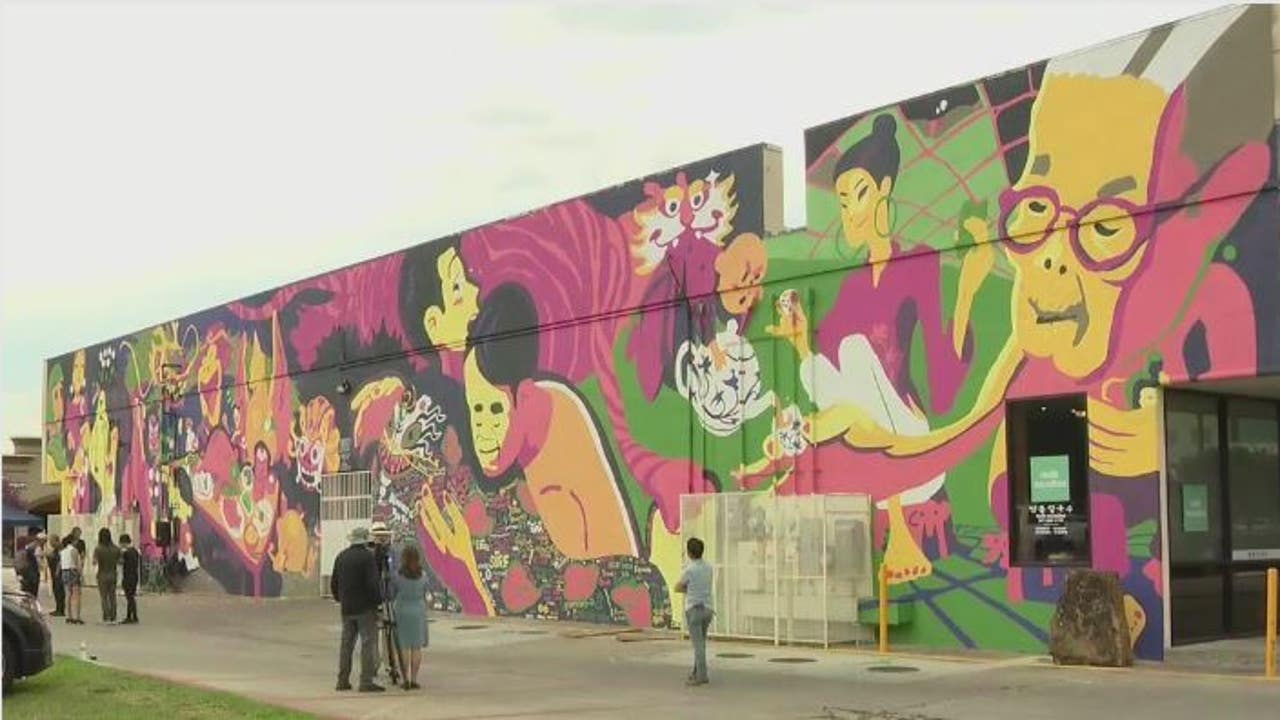
New community mural honoring Asian-American, Pacific Heritage unveiled in Houston's Asiatown - FOX 26 Houston

A new reason to visit Houston's Asiatown was unveiled Saturday. A Vietnamese non-profit teamed up with a local artist to honor Asian-American and Pacific Islander heritage through the area's first community mural.

Where businesses have closed and some targeted hate during the pandemic, the new mural titled "Longevity" is more than just artwork.

RELATED: 'We can still love each other,' first LGBTQIA Mosque to be opened in Houston

"Over here we have wind scraping, very common in Vietnam, China, all the southeast Asian countries," explains artist Thomas Tran.

The 25-year-old from Alief took the project’s theme "Heritage and Community Health" to new heights with the nearly two-story painting off Bellaire Boulevard, facing the H Mart Grocery Store.

Saturday morning’s unveiling was attended by contributing organizations and public officials celebrating the largest work in Asiatown and its first mural depicting the array of representation in the area.

"This area, and really the whole city of Houston, is such a melting pot," says Theresa Trinh, Executive Board President of the Vietnamese Culture and Science Association.

MORE ERACE THE HATE

"This Asiatown area consists of so many different Asian cultures, not just Vietnamese as I am. But on this mural, you’ll see a depiction of the Korean culture, the Filipino culture, and also the south Asian cultures," she adds.

The Vietnamese Culture and Science Association funded most of the $10,000 project through grant money in partnership with Houston In Action and the Houston Arts Alliance. To complete the project, VCSA called on Houstonians to use Tran’s plan to have volunteers "paint by the numbers" by picking a color and filling in the assigned pieces. More than 200 people signed up. For days, crews worked 4 p.m. until midnight until the mural was finished in less than a week.

The mural’s Asian-American Pacific Islander themes extend to other cultures as well. There's the pictured Vietnamese eucalyptus oil, a "cure-all" Tran says is an inside joke that mothers and grandmothers use on any ailment. Also, the longing for acceptance is depicted with a father and son embrace that Tran says touches on strained relationships between American kids and their immigrant parents.

"Maybe this kid was coming out or wants to pursue arts instead of engineering - this is maybe like the happy ending to a tough conversation," he says.

MORE HOUSTON NEWS

Local leaders say one goal of the project is to bring more cultures together by opening up about shared experiences, including discrimination.

"The way we react against it is to join each other - for the Asian community to support the Black community. For the Black community to support the Hispanic community, and so on and so forth," says Gene Wu, State Representative of District 137. "We will get through this together."

He says the mural is also an invitation for others to get to know Asiatown just as much as their own neighborhoods. 

"I think this is a welcome sign, a love letter to the rest of Houston saying, ‘come and see how beautiful this is; come and see our community," says Wu.

Adblock test (Why?)


"asian" - Google News
June 05, 2022 at 06:41AM
https://ift.tt/xv7qwoa

New community mural honoring Asian-American, Pacific Heritage unveiled in Houston's Asiatown - FOX 26 Houston
"asian" - Google News
https://ift.tt/dgD24x5
Shoes Man Tutorial
Pos News Update
Meme Update
Korean Entertainment News
Japan News Update

Search

Featured Post

Rubin Museum, Haven for Asian Art, to Close After 20 Years - The New York Times

It is the first major art museum in New York to close within recent memory. The museum had financial challenges and has faced accusations o...

Postingan Populer