Rechercher dans ce blog

Tuesday, December 25, 2018

Five Killed in China as Hijacked Bus Crashes into Pedestrians

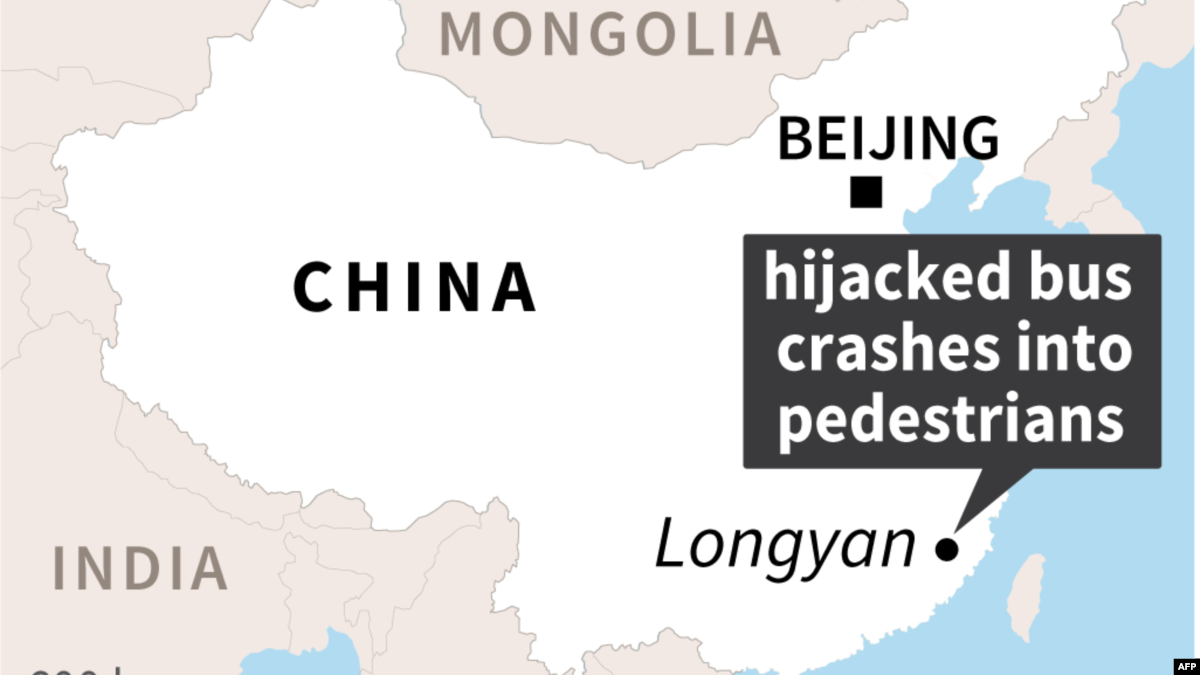
At least five people were killed and 21 injured after a hijacked bus crashed into pedestrians in east China's Fujian province on Tuesday afternoon, state media reported.

A hijacker carrying a knife has been detained and is being investigated by local police, state television CGTN reported.

The incident happened at about 3:20 pm in the city of Longyan, the local Minxi Ribao newspaper reported. A policeman was among the five confirmed dead.

In a video posted by Duowei news, a Chinese media outlet based in the US, several injured people were lying on the street near a crashed bus, its front badly damaged.

It also showed police wrestling a person to the ground.

Blood could also be seen on the steps of the bus, which had been stopped in the middle of a road.

The hijacker had attacked a female passenger before taking control of the bus, Duowei reported.

The suspect has not been identified and Longyan public security bureau declined to comment when contacted by AFP.

China has suffered a spate of similar incidents this year.

In late November, a car ploughed into a group of children crossing a street in front of an elementary school in the northeastern Liaoning province, killing five people and injuring at least 19.

The driver said he "chose his victims at random" and had reportedly been contemplating suicide due to domestic troubles before the tragedy occurred.

In October, three people were killed when a man fleeing after committing a stabbing drove into a crowd and attacked onlookers in the eastern province of Zhejiang.

The month before, a man ploughed a truck into a crowd in Hunan province and went on a rampage, attacking onlookers with knives and a shovel. Eleven died and 44 were injured.

Let's block ads! (Why?)

Read More Five Killed in China as Hijacked Bus Crashes into Pedestrians : http://bit.ly/2AePWfD

Monday, December 24, 2018

Scandal-Plagued Facebook Goes on Charm Offensive in Vietnam   

Before Facebook, Vu Kim Chi thought something was lacking in her job, which is to promote the economy in and around Vietnam's famed Ha Long Bay. Posting updates to her department's website, or photocopying missives to send to constituents, she said, was mostly one-sided.

But after she set up an official Facebook page for Quang Ninh province, the conversations started to flow in both directions, between Chi and the local residents or businesses. That's why, when it comes to social media, she thinks more civil servants need to catch up with the rest of the country.

"Social media, especially the Facebook application, is really used a lot in Vietnam," said Chi, who is deputy head of the province's investment promotion and support office. "But for public agencies that use it as a tool to interact with people and businesses, it's still not necessarily used a lot."

Facebook on charm offensive

Even as governments around the world are demanding more accountability and transparency from Facebook, public officials in Vietnam are looking for more ways to use the website. And Facebook is happy to oblige.

The company is on something of a charm offensive in Vietnam, where it has roughly 42 million members, nearly half the country. Besides sending top officials to visit Vietnam last year, Facebook has been instructing small businesses on how to sell their products on the site, and now it is giving civil servants like Chi advice for engaging with the public.

The chance to win some good will in Vietnam comes at a time when pressures are piling up on Facebook both inside the country and abroad. Globally, it has been accused of complicity in plots to convince voters to vote for Brexit or for candidate Donald Trump, as well as in what the United Nations calls ethnic cleansing in Myanmar. The company reportedly paid for research that could damage its critics' and competitors' reputations, as well as gave users' data to dozens of other firms without consent.

New cyber law

In Vietnam, the government told advertisers to boycott Facebook and other sites in response to users' postings that criticized the one-party state. Next month, the country will enact a cyber law requiring firms to store data domestically, which Facebook opposes.

But those troubles were not front and center at a workshop in Ho Chi Minh City this month where a company representative gave bureaucrats tips on making a Facebook page.

"We have to understand and put more attention to the social aspect of the platform," said Noudhy Valdryno, who handles government outreach for Facebook. "That means you have to understand your followers, who are they, where do they live, what are their interests? Then you can formulate an accurate strategy to engage with your followers."

The workshop included suggestions for government officials, such as posting updates on Facebook at regular intervals, shooting videos vertically to retain the attention of mobile users, and encouraging conversations among followers on the page.

Tech companies welcome

The event was an example of how Vietnamese officials are open to working with the tech company. It is so ubiquitous in the Southeast Asian country that when Vietnamese people say "social media" they mean Facebook, and when asked what newspapers they read, they give the answer: Facebook.

"What we're talking about is effective use of technology in this day and age to achieve our goals," said Le Quoc Cuong, vice director of the Ho Chi Minh City department of information and communications. "What we're looking for is being effective, being engaging and enhancing cooperation between the government and the people."

Chi says more Facebook data would help her better engage with residents around Quang Ninh, a northeastern province that hugs the Pacific Ocean on one side and the Chinese border on another. She would like regular reports, perhaps every month, with information to help analyze the province's fan page, from key words to number of "likes." So as many people worldwide have begun to decry tech companies for abusing and cashing in on users' data, there are those who still continue to see untapped potential in gathering further data.

Let's block ads! (Why?)

Read More Scandal-Plagued Facebook Goes on Charm Offensive in Vietnam    : http://bit.ly/2EPreq2

US Judge Orders North Korea to Pay $500M in Student’s Death

A federal judge on Monday ordered North Korea to pay more than $500 million in a wrongful death suit filed by the parents of Otto Warmbier, an American college student who died shortly after being released from that country.

U.S. District Judge Beryl Howell harshly condemned North Korea for “barbaric mistreatment” of Warmbier in agreeing with his family that the isolated nation should be held liable for his death last year. She awarded punitive damages and payments covering medical expenses, economic loss and pain and suffering to Fred and Cindy Warmbier, who alleged that their son had been held hostage and tortured.

Warmbier was a University of Virginia student who was visiting North Korea with a tour group when he was arrested and sentenced to 15 years of hard labor in March 2016 on suspicion of stealing a propaganda poster. He died in June 2017, shortly after he returned to the U.S. in a coma and showing apparent signs of torture while in custody.

In holding the North Korean government liable, Howell accused the government of seizing Warmbier for “use as a pawn in that totalitarian state’s global shenanigans and face-off with the United States.”

“Before Otto traveled with a tour group on a five-day trip to North Korea, he was a healthy, athletic student of economics and business in his junior year at the University of Virginia, with ‘big dreams’ and both the smarts and people skills to make him his high school class salutatorian, homecoming king, and prom king,” the judge wrote. “He was blind, deaf, and brain dead when North Korea turned him over to U.S. government officials for his final trip home.”

The arrest and death of Warmbier came during a time of heightened tension between the U.S. and North Korea over the country’s nuclear weapons program. President Donald Trump held a first-of-its-kind summit with North Korean leader Kim Jong Un in June 2018 and plans another next year.

The judgment may be mostly a symbolic victory since North Korea has yet to respond to any of the allegations in court and there’s no practical mechanism to force it do so. But the family may nonetheless be able to recoup damages through a Justice Department-administered fund for victims of state-sponsored acts of terrorism, and may look to seize other assets held by the country outside of North Korea.

Fred and Cindy Warmbier, who are from a suburb of Cincinnati, said they were thankful the court found the government of Kim Jong Un “legally and morally” responsible for their son’s death.

“We put ourselves and our family through the ordeal of a lawsuit and public trial because we promised Otto that we will never rest until we have justice for him,” they said in a statement. “Today’s thoughtful opinion by Chief Judge Howell is a significant step on our journey.”

The lawsuit, filed in April, describes in horrific detail the physical abuse Warmbier endured in North Korean custody.

When his parents boarded a plane to see him upon arrival in the U.S., they were “stunned to see his condition,” court documents say.

The 22-year-old was blind and deaf, his arms were curled and mangled and he was jerking violently and howling, completely unresponsive to his family’s attempts to comfort him. His once straight teeth were misaligned, and he had an unexplained scarred on his foot. An expert said in court papers that the injuries suggested he had been tortured with electric shock.

A neurologist later concluded that the college student suffered brain damage, probably from a loss of blood flow to the brain for five to 20 minutes.

North Korea has denied that Warmbier was tortured and has said he contracted botulism in custody, though medical experts said there was no evidence of that.

The complaint also said Warmbier was pressed to make a televised confession, then convicted of subversion after a short trial. He was denied communication with his family. In June 2017, his parents were informed he was in a coma and had been in that condition for one year.

Though foreign nations are generally immune from being sued in U.S. courts, Howell cited several exceptions that she said allowed the case to move forward and for her to hold North Korea liable. Those include the fact that North Korea has been designated by the U.S. as a sponsor of terrorism, that the Warmbiers are U.S. citizens and that North Koreans’ conduct amounts to torture and hostage taking.

The penalty awarded by Howell to the Warmbiers and to Otto Warmbier’s estate includes punitive damages as well as damages for economic losses, pain and suffering and medical expenses.

The lawsuit was brought on the Warmbiers’ behalf by Richard Cullen, a prominent Virginia lawyer and former U.S. attorney. He told The Associated Press that while “nothing will ever bring Otto back to the Warmbiers or erase their memories of his horrid last 18 months,” the judge’s order was “very good news for his family and friends.”

Let's block ads! (Why?)

Read More US Judge Orders North Korea to Pay $500M in Student’s Death : http://bit.ly/2Rld99O

Tsunami Victims Fear Another Eruption in Indonesia

China's Legislature Takes Up Law to Ban Forced Tech Transfer

China's legislature is considering a law to ban local governments from forcing foreign companies to hand over technology, an issue that helped to spark Washington's tariff war with Beijing.

Beijing has long denied companies are required to trade technology for market access. But officials including Premier Li Keqiang promised this year to crack down as tensions with Washington heated up.

The official Xinhua News Agency said a proposed foreign investment law taken up Sunday by the national legislature would make clear officials cannot "force the transfer of technology" as a condition of business ventures.

Washington and Beijing have raised tariffs on billions of dollars of each other's goods in a dispute over American complaints China's industry plans are based on theft of technology and violate its market-opening obligations.

Let's block ads! (Why?)

Read More China's Legislature Takes Up Law to Ban Forced Tech Transfer : http://bit.ly/2Ag53Wa

Famous Australian Yacht Race Remembers 1998 Tragedy

US Defense Chief’s Resignation Stirs Doubts in Asia about Help Resisting China

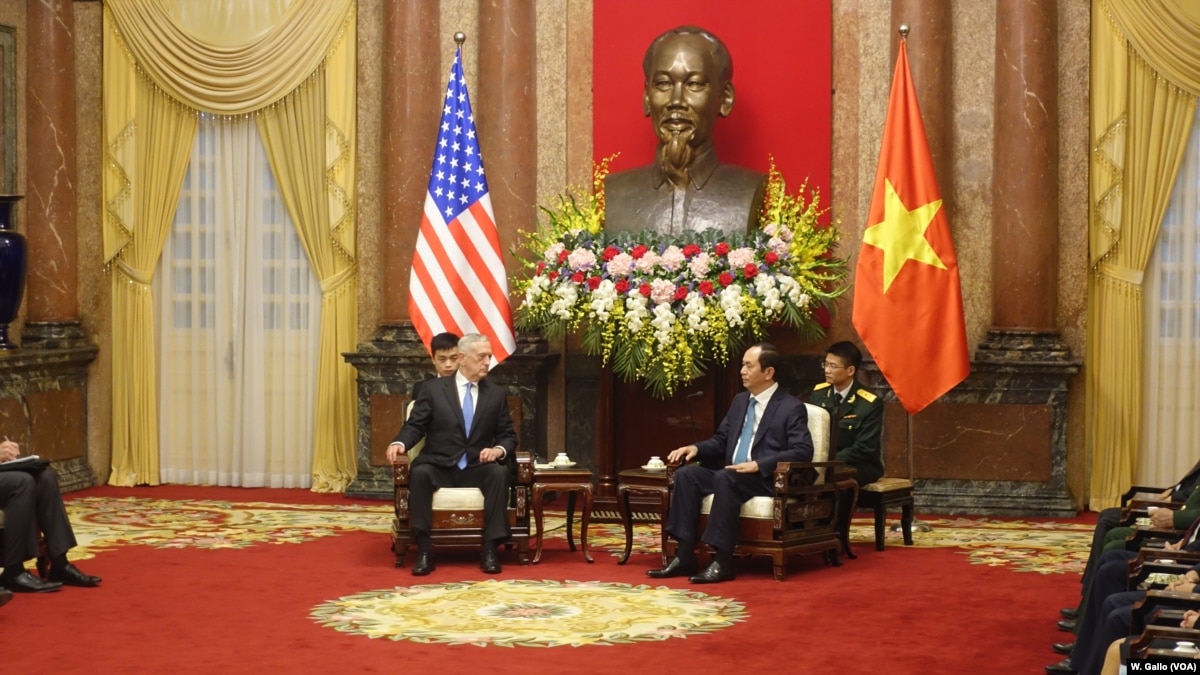
U.S. Defense Secretary James Mattis visited Vietnam twice this year and suggested in October stronger relations as China bears down on Vietnamese maritime claims. In the Philippines a month later, Mattis swore to uphold a decades-old military alliance that helps Manila resist China. A U.S. naval ship passes through the South China Sea every couple of months or so as support for keeping the resource-rich waterway open, not just for Chinese use.

Moments like these raised Southeast Asia’s confidence in U.S. support after some nervousness when President Donald Trump took office in 2017. Mattis will quit January 1, in turn shaking that confidence.

Beijing has drilled for oil, built up islands or passed ships in South China Sea waters claimed as well by Vietnam, the Philippines and three other Asian governments. Weaker than China, the Southeast Asian states hoped the United States would help. Mattis advocated close relations with allies to resist authoritarian states.

“I suspect many leaders, be they in Southeast Asia or elsewhere, will just roll their eyes and think, ‘here we go again’” after Mattis leaves, said Sean King, vice president of the Park Strategies political consultancy in New York. “Mattis is different, as he…holds such a critical life-and-death cabinet post and is a firm believer in America's alliances, as evidenced in his resignation letter to Trump.”

The U.S. Asia alliance spans democracies from Japan through South Korea and Taiwan into Southeast Asia. Many of those countries are trying to pare back the influence of China.

Sudden resignation

“It is clear that China and Russia, for example, want to shape a world consistent with their authoritarian model — gaining veto authority over other nations’ economic, diplomatic, and security decisions — to promote their own interests at the expense of their neighbors, America and our allies,” the 68-year-old ex-Marine Corps general wrote in his resignation letter to Trump.

“That is why we must use all the tools of American power to provide for the common defense,” the December 20 letter says.

Asian leaders found “reliability” in Mattis’s ties with Asia, said Huang Kwei-bo, vice dean of the international affairs college at National Chengchi University in Taipei. The defense secretary made a particular impression by attending the Shangri-la Dialogue twice, telling Asia’s major annual defense summit in 2018 that the U.S. government would help its “partners” improve protection of their maritime interests.

Vietnam, the Philippines, Brunei, Malaysia and Taiwan dispute Chinese expansion in the resource-rich South China Sea. Taiwan and Japan vie with Beijing separately over control of the East China Sea.

“He played a sort of force of reliability because at least as defense chief he did what he said and then when he made contact with every other country he was steady, giving them a sense of reliability, so other people’s trust in the United States won’t fall so fast,” Huang said.

Mattis quit a day after Trump announced the U.S. troop withdrawal from Syria, a move opposed by the defense department. European allies France, Sweden and the U.K. have already voiced concern about the resignation.

Among countries that claim the South China Sea, Vietnam will probably “miss” Mattis the most, King said. Vietnam has stood firmest against Beijing, he said, while other Asian maritime claimants look to the United States for security but to China for economic support.

Wait-and-watch phase

The U.S. withdrawal from Syria could show that Trump and his eventual new defense chief will later isolate Washington from its Asian allies, King said. China, he said, “would fill the vacuum.”

For the short term, expect leaders in Asia to wait nervously again as they did after Trump’s inauguration, analysts suggest.

“President Trump is playing demolition derby with his own cabinet and he's going to be distracted and this is not the time to mount any significant foreign policy initiatives,” said Alan Chong, associate professor at the S. Rajaratnam School of International Studies in Singapore.

“If there’s any more restrained member of Trump’s cabinet left, now is not that time, because a whimsical management team would pull the rug from under their feet at any time,” he said. “So I think things will remain static.”

Trump will probably look for a new defense chief “who will listen to him,” Huang said.

Trump has said he would appoint Deputy Defense Secretary Patrick Shanahan as acting secretary on January 1 to replace Mattis.

Let's block ads! (Why?)

Read More US Defense Chief’s Resignation Stirs Doubts in Asia about Help Resisting China : http://bit.ly/2BFzdlD
Search

Featured Post

Rubin Museum, Haven for Asian Art, to Close After 20 Years - The New York Times

It is the first major art museum in New York to close within recent memory. The museum had financial challenges and has faced accusations o...

Postingan Populer