Tuesday, May 1, 2018

Japan's Abe Seeks Support for Constitutional Revision
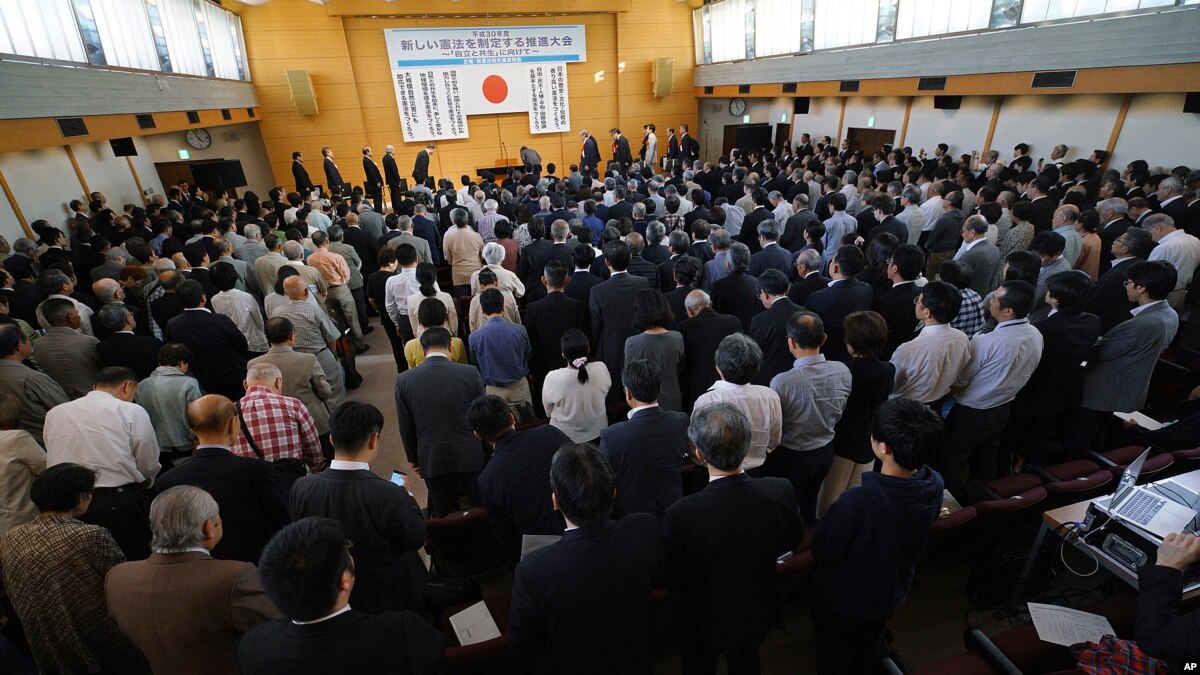
Japanese Prime Minister Shinzo Abe sought public support Tuesday for his long-cherished goal of revising the country's war-renouncing constitution amid widening scandals that have hurt his government's popularity.
Abe said he wants Japan's Self-Defense Force to be officially recognized by the constitution as the country's military. Opponents say the revision could expand Japan's military role beyond current limits.
"Finally, it's time for us to tackle a revision to the constitution. And it's you, the people, who are to play the primary role,'' Abe said in a statement read by a senior member of his ruling Liberal Democratic Party at an annual campaign rally for charter change. Abe is currently traveling in the Middle East.
Public opinion has been split despite an expanded campaign to drum up support for constitutional amendment in recent years. Demands for change have been led mainly by Abe's party, not the public. Abe's ruling block holds the necessary two-thirds majority in both houses of parliament to propose a revision, but its junior partner, the Komei party, is reluctant to accept a charter change.
Japan's postwar constitution renounces the use of force in settling international conflicts, and limits the military to self-defense, although Japan has a well-equipped modern army, navy and air force that work closely with the U.S. The Self-Defense Force, established less than a decade after Japan's World War II defeat, was once controversial, but is now widely accepted as Japan's legitimate military.
Abe, after seeing his party's earlier proposal for a more drastic revision of the constitution's war-renouncing Article 9 fail to gain public support, began arguing that many Japanese scholars still consider the Self-Defense Force unconstitutional and that the constitution needs to be revised to spell out its legitimacy.
Earlier Tuesday, thousands of participants in a May Day rally opposed the proposed constitutional revision and demanded Abe's resignation over his suspected role in widening cronyism scandals.
Abe's ruling party and its nationalistic supporters, such as the powerful lobby Nippon Kaigi, have advocated constitutional revisions for years. They say the 1947 charter, imposed by U.S. occupation forces after Japan's World War II defeat, is outdated and its pacifist restrictions make Japan vulnerable to a growing security threat from North Korea.
Earlier amendments proposed by the ruling party in 2012 were intended to restore prewar values centering on the emperor and on placing the national interest above individual rights in some cases. Abe's current proposed change to Article 9 was adopted by the ruling party in March.
Pakistan’s Minority Hazara Community on Hunger Strike Against Target Killing
[unable to retrieve full-text content]
Members of Pakistan’s Hazara community, a minority Shi’ite sect, are on a hunger strike for a third day against targeted killings their community has faced for years. VOA’s Ayesha Tanzeem has this report. Read More Pakistan’s Minority Hazara Community on Hunger Strike Against Target Killing : https://ift.tt/2I50q6oIndia-China Summit Does Little to Cool Border Tensions
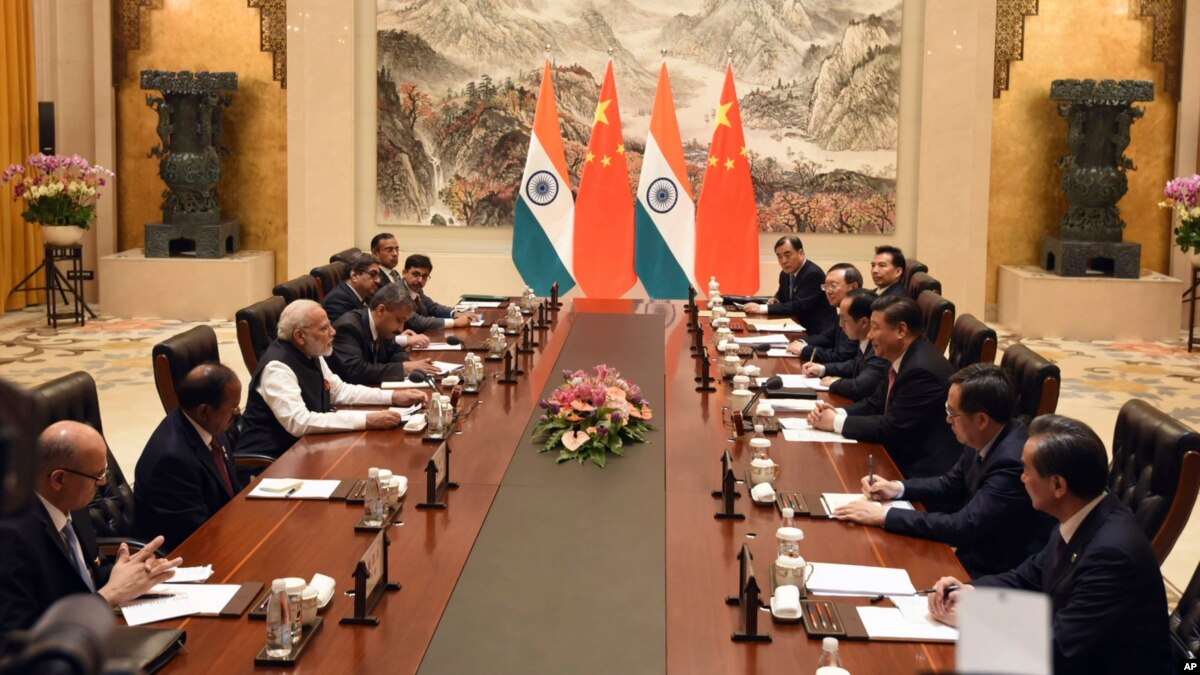
For New Delhi, the key takeaway of a recent meeting between the leaders of India and China is an agreement to maintain peace and tranquillity along their disputed, unsettled borders.
Held months after a dangerous military standoff in the Himalayan mountains raised fears of a wider conflict between the Asian giants, the talks - billed as an informal summit - last week in Wuhan, China, aimed at repairing their frayed ties.
However, analysts caution that New Delhi will have to wait to see whether the display of goodwill between Chinese President Xi Jinping and Indian Prime Minister Narendra Modi actually results in lowered border tensions.
India’s foreign ministry says the two leaders have issued "strategic guidance to their respective militaries" to strengthen communication and build trust and that both sides agreed to handle differences with maturity and through discussions.
“Really speaking that is the nub of the issue, of seeing that the number of transgressions and violations at the LAC (line of actual control) come down. We have to wait and see whether that happens or not,” said Jayadeva Ranade, head of the Center for China Analysis and Strategy in New Delhi. “The track record between China and India has not been very smooth,” he adds.
By "transgressions," Ranade refers to confrontations along the border that have occured when the two sides accuse each other of straying into each other's territory along un-demarcated stretches of their 3,500 kilometer long border. The incidents are for the most part minor, such as shouting matches between soldiers. At times, they have become serious.
India counted 426 incidents last year, sharply up from 273 in the previous year. It was seen as a sign of growing Chinese military assertiveness on the border.
Calming tensions
Some small steps have been taken to defuse tensions. An annual exercise between their armies is set to resume and officials say there is progress in setting up a long-pending hotline between their central military headquarters.
Such high level military communication is seen as necessary because existing mechanisms failed to prevent the 73-day face off at Doklam Plateau when India obstructed Beijing from building a road on a strip of territory at a mountain junction between China, India and Bhutan.
Neither side has lowered its guard at Doklam, even after troops stepped back last August. Both have reinforced their positions in the area, according to reports and satellite imagery. The Chinese made upgrades to airfields, helipads and other infrastructure just behind the standoff point, while India too reinforced its air power.
Srinath Kondapilli, a professor of Chinese studies at New Delhi’s Jawaharlal Nehru University said the meeting did appear to send a signal from the civilian leadership to cool border flare-ups. “If this percolates down to the military level, then we may possibly see some stability on the border area. But the breakthrough has not been achieved,” he said.
There is also little indication from the meeting between Modi and Xi that the two sides will expedite the resolution of their border dispute, which has made little headway despite many rounds of talks held since the 1980s say analysts. Each side claims large chunks of the territory controlled by the other.
Saying that both leaders had agreed they could handle their differences peacefully, Indian Foreign Secretary Vijay Gokhale said, “on the issue of the India-China boundary question, the two leaders endorsed the work of the special representatives in their efforts to find a fair, reasonable and mutually acceptable settlement.”
Ranade questioned whether this will translate into anything concrete on the ground. “It’s been said before. It’s been said at every meeting. Whether it does happen or not, we will see.”
Others point out that no concrete agreements were reached on issues that trouble the two countries, including a trade imbalance that has reached half a trillion dollars in China’s favor.
New Delhi has refused to change its position on staying out of Xi's grand Belt and Road initiative to build ports, railways and roads to expand trade across Asia, Africa and Europe and remains deeply suspicious of China’s investments in countries bordering India such as Nepal and Bangladesh.
"It appeared both sides are trying to buy time, no major announcements were made at this meeting,” said Kondapalli of Jawaharlal Nehru University.
Read More India-China Summit Does Little to Cool Border Tensions : https://ift.tt/2JJi1xPFeatured Post
Rubin Museum, Haven for Asian Art, to Close After 20 Years - The New York Times
It is the first major art museum in New York to close within recent memory. The museum had financial challenges and has faced accusations o...

Postingan Populer
-
asianpostmedia.blogspot.com Ex-CEO John Clendening slams his former employer for allegedly rewriting history to fend off attack from activi...
-
If you’ve swiped across TikTok, chances are you’ll have seen videos about the ABG aesthetic. From makeup and style tutorials to skits, the “...
-
Merdeka.com - Tahun lalu, organisasi teroris ISIS yang menguasai sebagian wilayah di Suriah dan Irak berhasil digempur. ISIS kehilangan wi...


